Creating a digital hub: how Revizto supported Arcadis on the Warringah Freeway Upgrade
Table of Contents
Arcadis’ recent and ongoing works on the Warringah Freeway Upgrade have been greatly assisted by Revizto, a platform that’s assisted in the delivery of what is one of Australia’s most complex and major infrastructure packages for an essential connection.
Even for a global design and consultancy firm of Arcadis’ scale, there’s always room for improvement and growth.
It’s this very belief and vision that’s led to the company maintaining a global presence in more than 70 countries, while playing a key role in delivering some of Australia’s most significant infrastructure projects to date, and into the future.
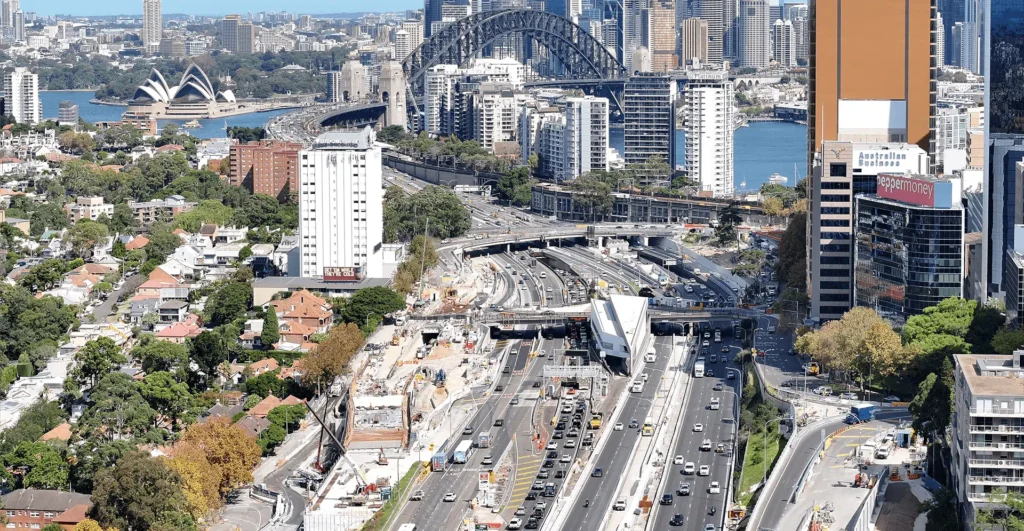
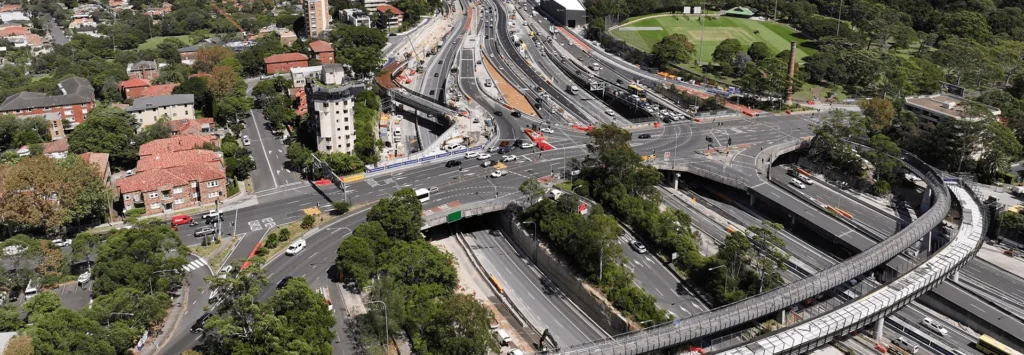
Included in this portfolio is the Warringah Freeway Upgrade, which is seeing Arcadis work with several major industry partners to deliver improved infrastructure for one of New South Wales’s essential arterial connections.
The Warringah Freeway is a major connection that links the Sydney Harbour Tunnel to the Gore Hill Freeway and ranks as the eighth busiest road in the state. It’s also one of the top 30 most congested road corridors in the nation.
To cater for future traffic demand, spurred on in part by an increase in traffic volume that will come with the future Western Harbour Tunnel, an upgrade is being delivered to take the pressure off the Sydney Harbour Bridge, Sydney Harbour Tunnel and Anzac Bridge.
As part of a joint venture with Jacobs and CPB, Arcadis is helping to deliver improvements to four grade separated interchanges, upgrades to 10 bridges and the establishment of 7.2 kilometres of retaining walls.
During an internal examination, Arcadis assessed its array of construction and digital delivery software, used for its vast variety of ongoing projects in the transport, electric vehicle infrastructure, estates, precincts and energy spaces, among others.
At the head of this assessment was Mitch Medway, Global Digital Engineering Director, Arcadis.
“Arcadis’ journey with Revizto started back in late 2021,” he says. “I joined Arcadis back in 2019 and one of the things that we identified was where we had gaps in our technological ecosystem.
“We didn’t really have a solution that would enable us to do sophisticated model coordination and assign issues back to people who were accountable for fixing those issues. Tools existed, but some of them just didn’t have what we needed, especially when we’re talking about tackling infrastructure projects at scale.”
Arcadis’ decision to adopt a new platform was also driven by a desire for clean workflows, interoperability with all of its tools, and an intuitive platform for both its own teams and joint venture partners.
All of which were an essential requirement before the commencement of works on one of the key infrastructure projects that now form part of Arcadis’ project portfolio.
“One of those key projects at the time of our initial adoption of Revizto was the Warringah Freeway Upgrade in Sydney,” Medway says.
In addition to Arcadis, each of the partners within the joint venture were existing Revizto users, helping to further streamline design and collaboration throughout the delivery of the project.
“We were fortunate that Revizto was already a known application with the stakeholders that were working on these projects. We weren’t just going in with a shiny new toy, it was already proven,” Medway says.
“We’ve always said that we should definitely look to invest in not just what we believe, but where our clients do as well, because that alignment can, at times, be part of the criteria when it comes to actually picking teams and winning more work.”
Built on a gaming engine, Revizto provides a single source of truth through a highly accessible and flexible BIM (Building Information modeling) platform.
Revizto transforms how AECO (Architecture, Engineering, Construction, and Operations) teams work by bringing the entire project and project team into one collaborative hub, to visualize, review and verify projects across the full life cycle.
Therefore, enabling faster decisions, reduced risk, and greater control by providing a user-friendly interface, ease-of-use, and fast onboarding for non-BIM skilled teams.
Architects, engineers, contractors, and owners can be all connected on one model, to assess both three- and two-dimensional spaces to identify potential clashes.
Beyond providing accurate, critical and detailed modelling and information, the collaborative nature of the platform continues to be a standout quality throughout the project lifecycle thus far, as Medway explains.
Revizto wasn’t just a design tool, it was a legitimate collaboration tool, and regardless of your role or the type of stakeholder that you were, that data was and is accessible to everyone.

Mitch Medway
Global Digital Engineering Director
Arcadis
“Just one example is the issue tracker inside of Revizto. Revizto collects the clash detection data, a process that can be automated to push into the issue tracker, which is more or less your repository or historical record of all issues that occur on the project. There we can search and retrieve that information, so can a project manager or anyone else involved in the project, who can access a visualization of that data in clean form.”
The effectiveness of the tool also “greatly” aided communication between different disciplines.
“Those clean workflows are so important,” Medway says. “If I’m a structural engineer and I need to send information really quickly to a civil engineer on what is a complex interface, Revizto can synchronize that information, regardless of the authoring platform, into one common area.
“If there’s alterations needed, that could take no more than five seconds for the model to be updated. That communication and those changes can happen in what is almost real-time.”
It’s this ‘single source of truth’ that’s helped Arcadis – within the joint venture – to establish a centralised hub, driven by the expertise of each project partner, as well as a desire to deliver the best possible project outcome for the community.
It’s invaluable to work within a collaborative digital hub, with every piece of information, point clouds, models, drawings and more in one spot. Not only that, but also every person that’s working on the project.
Mitch Medway
Global Digital Engineering Director
Arcadis
“It’s always been about the whole project lifecycle. Having all that information in one hub is how we can enable the speed and efficiency required to de-risk these major projects.”
Originally published in Roads & Infrastructure Magazine