What is Navisworks? Differences between Revit and Navisworks.
See how Revizto fits your workflow
Navisworks is Autodesk's coordination and project review tool - the one teams use to catch clashes, simulate construction sequences, and aggregate models from different software. This guide covers what it does, how it compares to Revit, and which version fits your team.
What is Navisworks?
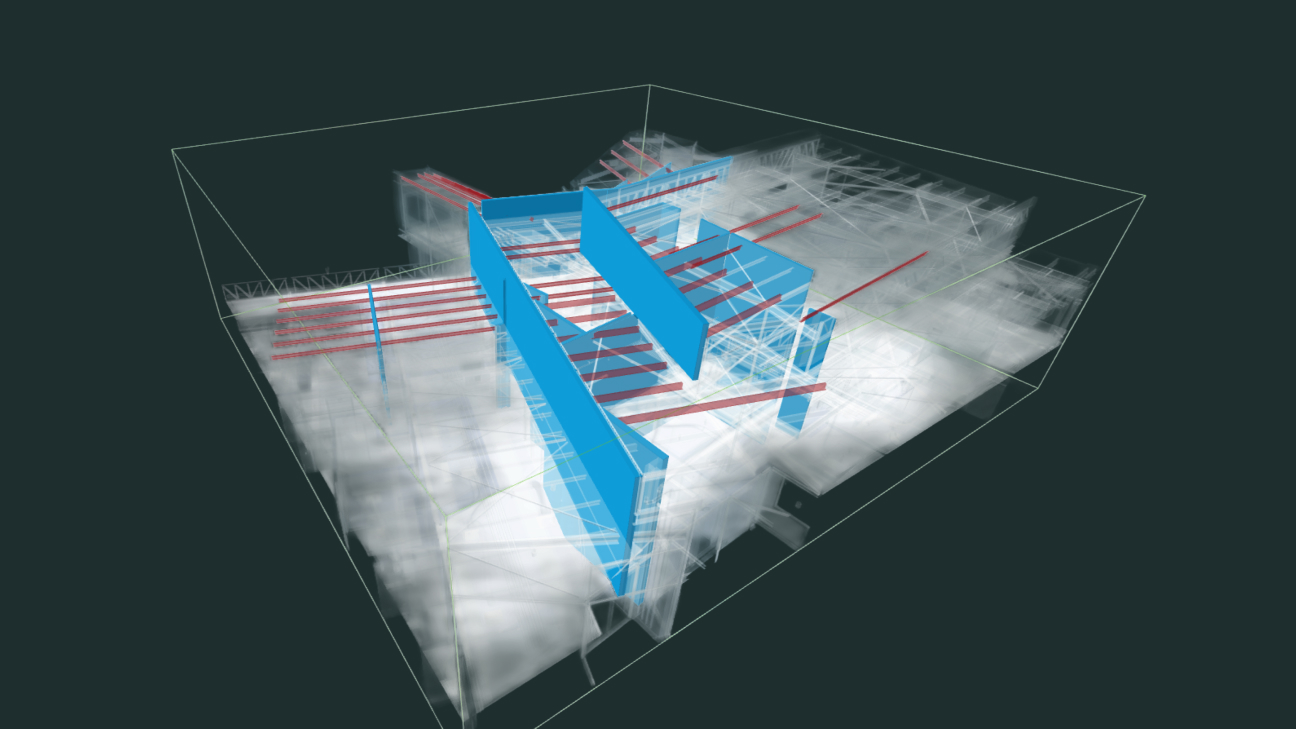
Autodesk Navisworks is a project review and coordination tool used across architecture, engineering, and construction. Its main job is to aggregate models from different authoring tools - Revit, AutoCAD, Bentley, and others - into a single federated view, so teams can run clash detection, simulate construction sequences, and review the full project before work starts on site.
Navisworks does not create geometry. It is not a design tool. What it does is take models made elsewhere and give teams a shared environment to interrogate them - finding conflicts between structural, mechanical, and electrical systems, checking construction schedules against the model, and producing coordination reports.
It comes in three versions: Navisworks Freedom (free viewer), Navisworks Simulate (review and 4D simulation), and Navisworks Manage (the full package, including native clash detection).
Features of Navisworks
Another important factor that needs to be brought up to answer the question "What is Navisworks?" correctly is the nature of the software in question. While Navisworks is a great solution on its own, it is at its best when used in tandem with various 3D design platforms and packages – AutoCAD, Revit, and so on.
This makes Navisworks a vital part of collaboration inside of pretty much any CAD or BIM project since it can not only combine and open various 3D models but also review them, run clash detection, measure various parameters, and so on. Navisworks' capabilities can also be expanded using a system of plugins, which allows for the addition of even more specific features like time simulation, interference detection, and photorealistic rendering.
Navisworks – packages and file types
Navisworks can provide a lot of features like clash detection, construction simulation, project scheduling, and more – but some of the more specific features would cost you more than the rest. Navisworks is provided in three different versions:
- Navisworks Freedom – The most basic version of the three, offering the most basic functionality of viewing Navisworks' own NWD files. The biggest advantage of this one is that it's completely free.
- Navisworks Simulate – A version of Navisworks that is considered a middle ground of sorts. It is cheaper than the full version but does not have some of the more complicated (and often necessary) features, such as native clash detection capability.
- Navisworks Manage – The complete version of Navisworks that offers the entire feature set of the software. It costs the most out of all the versions while also featuring the most extensive feature list.
We've also talked about how Navisworks supports many different file types, which is completely true, but it does not mean that Navisworks does not have its own file types. As such, Navisworks has several different file formats that are proprietary (just like pretty much any other Autodesk product), such as:
- .NWF file format – A standard Navisworks project file, mostly used to store a current project of yours; also contains links to all of the different models that it is connected to and working with.
- .NWD file format – A type of file that you should use when coordinating with other trades; this is a bit more simple of a file format, and it does not have any of the links to the original models like .NWF does.
- .NWC file format – A Navisworks cache file, created automatically whenever you're opening a native Navisworks file; it contains the current project's snapshot.
Benefits of Navisworks
Navisworks is a handy tool for project review – and here's a bit more detailed list of all the benefits that Navisworks can provide:
- Easy navigation inside of a model, with customizable viewpoints, set search feature, and so on.
- The ability to simulate the construction process allows all participants to be aware of the potential problems on-site.
- Overall ease of use for Navisworks as a whole, with the ability to view Navisworks' own .NWD files with absolutely no cost attached whatsoever.
- Ability to use specific settings and parameters in other projects thanks to Navisworks' exporting capabilities.
- Clash detection as a feature saves a lot of time for stakeholders in the construction process. It allows one to see the potential problems as early as the design stage when it is much easier to fix such mistakes than fixing something as the building is being constructed.
- The overall workflow is also much more manageable with Navisworks since it allows for an even better experience for collaborations. This is possible due to the integration between Navisworks and Autodesk's own BIM 360 Glue software – it enables users to share all kinds of information through the cloud, including Navisworks project files.
Using Navisworks for clash detection?
Revizto connects Navisworks workflows with real-time issue tracking, so clashes get assigned, tracked, and resolved - not just logged.
Navisworks and BIM
Since BIM seems to be growing rapidly in recent years, it's not uncommon for people to ask a relatively simple question: Can Navisworks be used for BIM projects? The short answer is yes. The long answer would require a bit of explanation.
As we've mentioned before, the primary purpose of Navisworks is to act as a project review tool. This feature alone makes Navisworks a pretty much perfect fit for any BIM project out there since coordination and collaboration are valued extremely high on the list of priorities when it comes to BIM.
The ability of Navisworks to aggregate multiple different model types into one single project to act as a singular source of truth is more or less the textbook definition of BIM. The addition of easy navigation for your BIM Navisworks models is also a massive advantage from a single standpoint of user-friendliness and simplicity.
However, that's not the entire argument, either. We've mentioned before that Navisworks has more sophisticated features as an exclusive to Navisworks Manage – the "full" version of the software. One such feature is clash detection – an essential feature for BIM since it leverages intelligence about different models to resolve potential problems on the design stage.
Other BIM Navisworks advantages are scheduling, 3D animations, fly-throughs and overviews, compatibility with IFC models (ISO 19650 standard), and more. These factors should make it pretty obvious how beneficial it is to use Navisworks for your BIM projects.
See how teams coordinate BIM with Revizto
Real projects. See how construction teams combine model review with issue management to cut rework and speed up handover.
Navisworks vs Revit
Another rather popular question that gets associated with the topic of Navisworks is the matter of comparison to other software in the field. A good example of that is the "Navisworks vs Revit" topic – even though it should not be that big of a topic in the first place.
The truth is that solutions like Navisworks and Revit cannot be compared directly since they have a somewhat different purpose, and only some of their features are relatively similar. In reality, Navisworks and Revit are often used as complementary software for each other – since it's not uncommon for projects to use multiple different software appliances in the first place.
To sum it up – Revit is a 3D modeling software, and Navisworks is a project review software. The former is used to generate 3D models for various purposes and provide documents. In contrast, the latter takes 3D models from multiple sources and combines them to check for potential issues.
And these two pieces of software are quite good at complimenting each other, too. For example, while Navisworks cannot create models and designs from scratch as Revit does – it is capable of running clash detection, making the compatibility problems for Revit models appear far less than usual. And, of course, both of these software services are used for BIM projects – even if their purposes are different.
See Revizto in action
Book a personalized demo and see how Revizto fits alongside your Navisworks and Revit workflows.
Conclusion
Navisworks is a rather helpful software for many different reasons, with the main one being project review. It can work with all kinds of software types, run clash detection and construction simulation, and contribute to a BIM project in several ways. All in all, this article should be a rather convincing answer to why Navisworks is such a great software.
FAQs
Navisworks is used for project review and coordination in construction and engineering. Its primary functions are clash detection (finding conflicts between structural, MEP, and architectural models), 4D construction simulation (linking the model to a schedule), and model aggregation (combining files from Revit, AutoCAD, and other tools into one federated view). It is not a design tool - it does not create geometry. Teams use it to review models before construction starts to catch problems early and reduce rework on site.
Revit is a design and documentation tool - architects and engineers use it to create building models. Navisworks is a review and coordination tool - project teams use it to check those models for clashes, simulate construction sequences, and coordinate across disciplines. They are complementary, not competing. The typical workflow is to design in Revit, export to Navisworks for clash detection and review, then resolve issues back in Revit. Navisworks can also aggregate models from non-Revit tools like AutoCAD, Bentley, and SketchUp into a single federated model.
Autodesk offers three versions of Navisworks. Navisworks Freedom is a free viewer that opens NWD files only - no editing, no clash detection. Navisworks Simulate adds 4D construction simulation and project scheduling but does not include native clash detection. Navisworks Manage is the full version, including Clash Detective (native clash detection), TimeLiner (4D simulation), and Animator. Most professional coordination teams use Navisworks Manage. Freedom is used mainly for sharing models with stakeholders who only need to view them.
Navisworks supports a wide range of 3D file formats, which is one of its main strengths for model aggregation. It reads native formats from Autodesk tools (RVT from Revit, DWG from AutoCAD), as well as files from other vendors including IFC (open standard), DGN (Bentley MicroStation), SKP (SketchUp), and formats from tools like Tekla, ArchiCAD, and others. Navisworks also has its own formats: NWC (cache files for individual models) and NWD (packaged federated models for sharing). NWF files store references to the original source files rather than embedding them.
Navisworks Freedom is free. It lets you view NWD files created in Navisworks Manage or Simulate, but it has no editing, markup, or clash detection capabilities. Navisworks Simulate and Navisworks Manage are paid subscriptions available through Autodesk, typically as part of an AEC Collection or as standalone licences. A free trial is available for the paid versions. For teams that need coordination and clash detection rather than just viewing, the paid versions are necessary - Freedom is primarily for sharing completed models with clients or stakeholders.
Navisworks and Revizto serve different parts of the coordination workflow. Navisworks is strong for clash detection and 4D simulation during the design and pre-construction phase. Revizto connects that model-based coordination to live issue tracking, field access, and project management - making it easier for site teams, owners, and project managers to act on what the coordination team finds in Navisworks. Teams often use both: Navisworks for the technical clash review, and Revizto for tracking resolution, managing RFIs, and giving field teams access to the coordinated model throughout construction.