Building a company that the AECO industry can rely on
See how Revizto fits your workflow
"Built to last" is a phrase thrown around a lot in construction technology. This industry, more than most, should care deeply about what it actually means.
Last year, Revizto grew annual recurring revenue by 23%. We hit 13,000 active monthly projects around the world. We grew monthly active users by 25%. And we remained profitable for the sixth consecutive year.
I mention them not because I think growth metrics tell the whole story, but because in this case they tell an important one. What teams increasingly tell us they want is a different kind of reliability: a partner that keeps innovating on the workflows they actually use, rather than maintaining what was built a decade ago. That's the standard we hold ourselves to.
What profitable growth actually means for you
When a software company is burning through investor capital to chase growth, it makes different decisions than a company that has to earn its way forward. It over-promises on roadmaps. It acquires rather than builds. It raises prices when the funding runs out. It pivots to whatever the market is excited about, whether that's useful to its customers or not.
We've seen this cycle play out in construction technology before. Promising tools get acquired and folded into suites that don't serve the workflows they were built for. Pricing structures change after contracts are signed. Features get deprecated when the business model shifts.
The teams using those tools pay the price. Not the investors.
At Revizto, everything we make goes back into the product, the people, and the quality of what we deliver. That's not a mission statement. It's how we've operated for seventeen years. You can see what that looks like in practice across the Revizto Collaboration Hub — a platform that has been built deliberately, and in response to what the industry actually needs.
Building the team for the next chapter
This year I'm more excited about our team than at any point in Revizto's history.
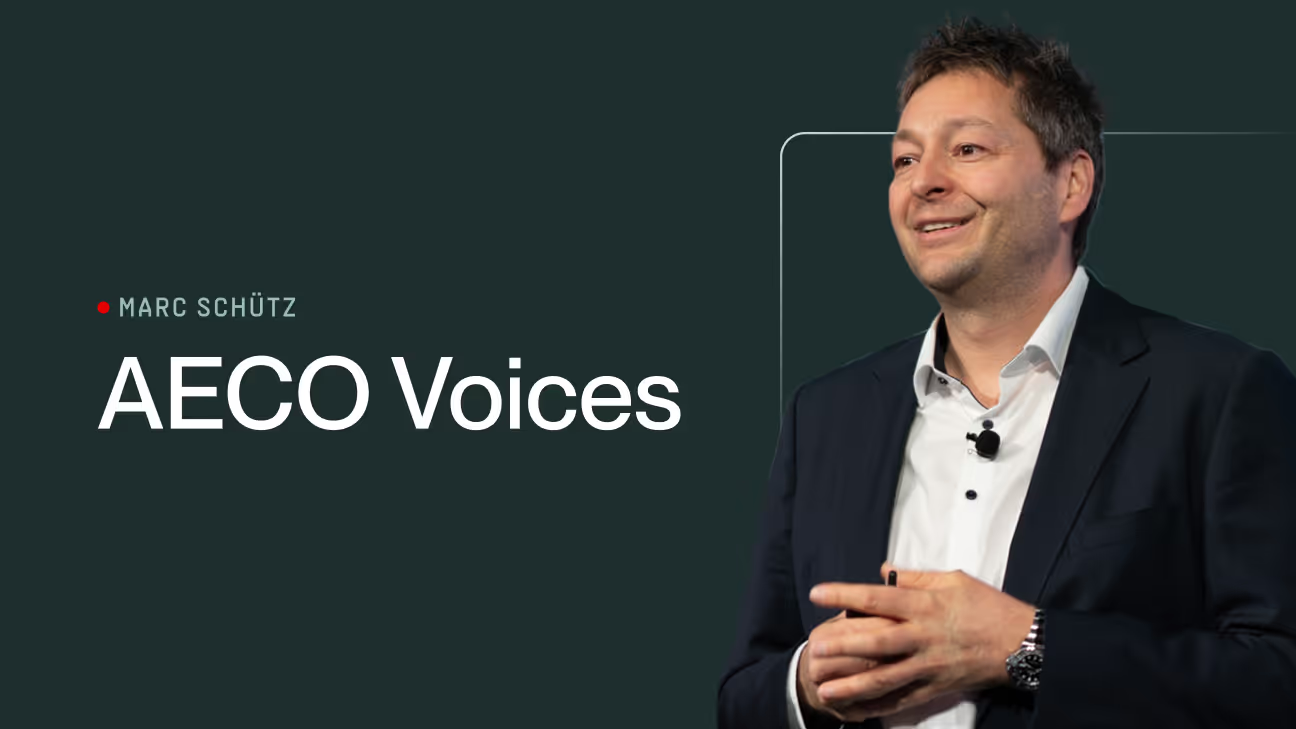
Marc Schütz joined as Chief Product Officer (CPO) after twenty years at Bentley Systems and PTC, bringing a product development rigor that is already changing how fast we move from customer feedback to shipped features. We're prototyping in days. We're validating with real users before we build. We're moving faster without moving carelessly.
These aren't hires made because we raised a round and needed to scale headcount. They're hires made because the business can support them — and because the moment requires them.

Scale that serves the customer
The projects being delivered on Revizto in 2025 and 2026 give me a clear picture of where the industry is heading and what it needs from us. A national archive in New Zealand built to withstand seismic forces that would destroy most structures. A giga-project in the UK built on the former Concord runway. A fleet of data centers at a scale the industry has never attempted before. A resort in San Diego delivered ahead of schedule and on budget — where we happened to hold our Made Right Conference in 2026.
These projects share a common thread. They are large, complex, and unforgiving of coordination failures. And the teams delivering them chose Revizto because it scales with the complexity of the work, not against it.
That's what sustainable technology looks like. Not a platform built for a funding cycle. A platform built for the long term — for the projects, the teams, and the industry that depends on it.
Get in touch with my team and we'll show you what it looks like for yours.

FAQs
Construction teams should look for software vendors that demonstrate sustained profitability, a consistent product roadmap, and a track record of building rather than acquiring. Companies that rely on external capital to fund growth are more likely to change pricing, deprecate features, or pivot strategy in ways that disrupt the teams depending on their tools.
Profitability in a construction software company signals that its growth is funded by the value it delivers to customers, not by investor capital. Profitable vendors are less likely to over-promise on features, raise prices unexpectedly, or be acquired and absorbed into platforms that don't serve the original use case. For construction teams managing multi-year projects, this stability is a critical consideration.
Construction software that is not financially sustainable poses significant risks to project continuity. If a vendor runs out of capital, is acquired, or pivots its business model mid-project, teams can face disrupted workflows, data access issues, and forced migrations. The true cost of switching platforms mid-project — in time, training, and lost institutional knowledge — is rarely accounted for when signing the original contract.
Construction software scales with project complexity by maintaining performance and coordination capability as model size, team size, and issue volumes increase. Platforms built on robust architecture can support giga-projects, multi-discipline coordination across global teams, and high-frequency clash detection without compromising the speed and reliability that field teams depend on.
Construction software that grows through acquisition often combines tools that were not designed to work together, resulting in fragmented workflows, inconsistent user experiences, and features that are maintained rather than developed. Organic development, by contrast, allows vendors to build cohesively in response to real customer feedback, resulting in platforms where capabilities are genuinely integrated rather than bolted together after the fact.