Why time is the hidden cost killing AEC technology adoption
See how Revizto fits your workflow
There's a story the AEC industry tells itself about construction technology adoption, and it goes like this: firms would invest in better tools if only they could afford them.
Revizto's 2026 Bridging the Gap data says that story is wrong. And has been for a while.
The four barriers to technology adoption in construction, reordered
When 2,006 AEC professionals were asked what has been the biggest barrier to adopting new technology, the answers put cost in fourth place:
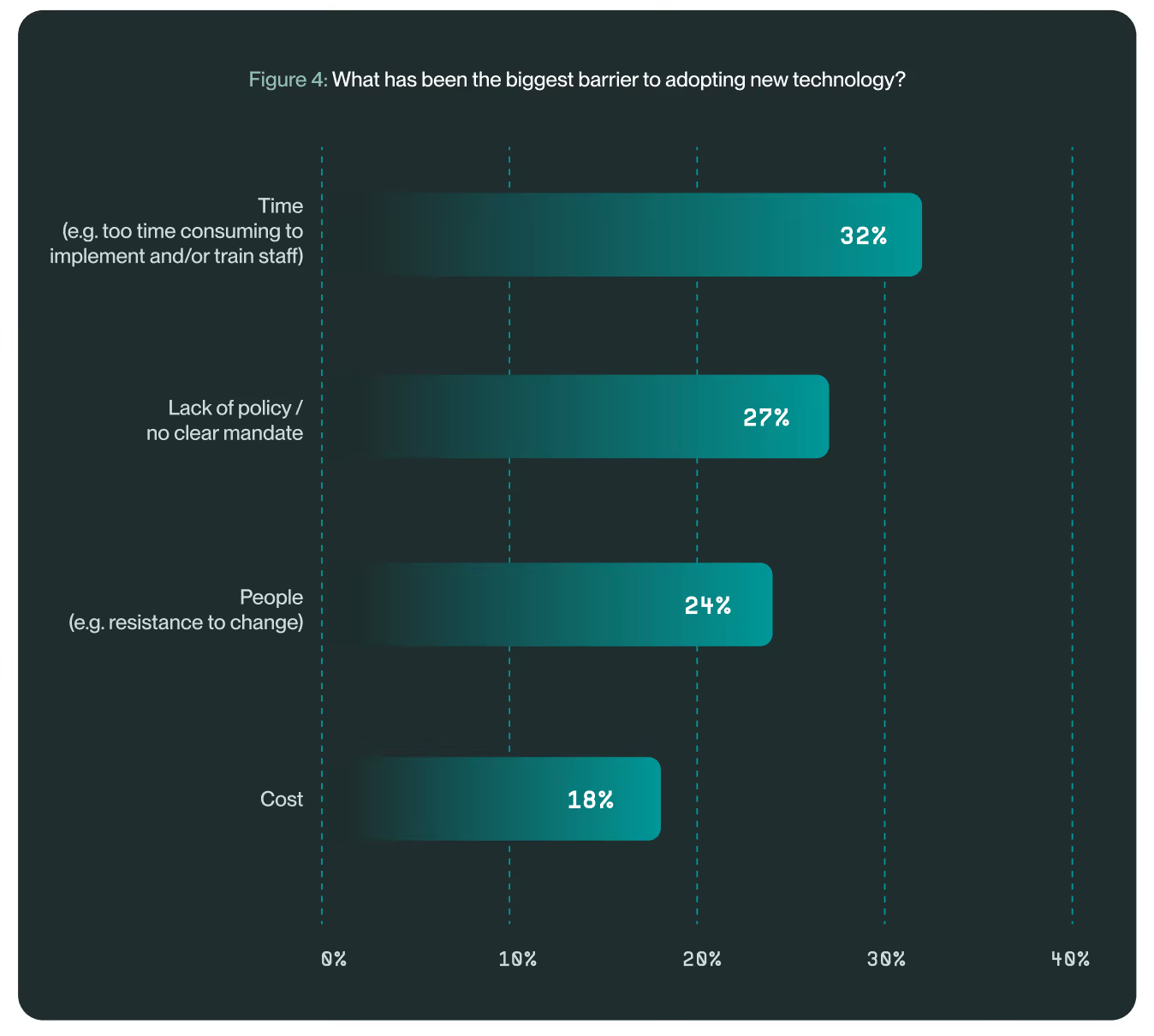
Three of the top four BIM adoption barriers aren't commercial. They're about capacity, leadership, and change. And cost, the barrier that dominates procurement conversations, is falling as a concern, not rising.
That reordering matters. Because the business case that gets approved in 2026 isn't the one with the sharpest ROI calculation. It's the one that accounts for what the data is actually saying about where construction software implementation stalls.
Why "time" is the real cost
When a BIM manager or a head of digital delivery pushes back on a new tool, the word they say is often "cost." The word they mean, increasingly, is "time."
Three things happen during a rollout that all cost time:
- Implementation eats project hours. The hours come from live delivery — not from a spare training budget sitting off to the side.
- Training pulls the most stretched roles off the job. BIM leads, discipline coordinators, and digital specialists are already the most overloaded people on any project. They're the ones who have to learn the tool first.
- Parallel workflows create quality risk. When a team is running old and new systems side by side, that's when mistakes creep in. Unlike a software license, you can't amortize that window across a fiscal year. It lands on one project, usually the live one.
In an industry where 92% of firms are already running over budget by 6% or more, there is no slack to absorb months of team distraction. So tools that require it don't get approved — regardless of what they cost.
"Technology integration often gets blamed, but in my experience the real challenge is people integration. Rework, budget overruns, and coordination failures usually come down to alignment between designers, trades, and owners."
Sal D'Ambrosia, Director of Construction Technology, Wm. Blanchard Co.
The tool conversation is really a team conversation. Which is why the firms getting AEC digital transformation right are spending less energy comparing features and more energy asking how quickly the team will actually be productive.
Closing the digital skills gap by simplifying, not expanding
The same 2026 data contains a second finding that reinforces the point. When asked how they're addressing the digital skills gap in construction, firms ranked their top strategies as follows:
That's a significant signal. The instinct five years ago was to bring in the most capable tool for each job. The instinct now is to bring in the tool the team can actually absorb — and to remove the tools that have become a tax on delivery.
This is where consolidation stops being a cost story and starts being a time story. Every tool you remove from the construction tech stack is a training load you don't carry. Every integration you collapse is a handoff you don't spend hours managing. Every workflow you simplify is an hour given back to the people delivering the project.
That's where real AEC workflow efficiency comes from — not from adding capability, but from removing friction.
What this changes for digital leads
If you're leading construction software implementation inside an AEC firm in 2026, the takeaway is practical. The evaluation criteria that win approval are changing. Instead of leading with feature depth, lead with:
- Time to productivity. How long until the first team is productive in it — not "fully trained"?
- Workflow trade-off. What does the existing workflow give up, and what does it gain?
- Knowledge carryover. How much of the team's current knowledge transfers directly into the new tool?
- Implementation load. What's the realistic disruption to the project already in flight?
Those questions matter more than feature checklists. A tool that takes six months to roll out across a BIM team — no matter how sophisticated — won't get rolled out.
"Bringing a coordination platform into the project early in the design stage would improve overall design development and ultimately lead to a smoother construction phase."
Francesca Lofiego, Digital Lead, Structure Tone UK
The tools that absorb well are the ones that come in early, fit the workflow, and earn their place without demanding a parallel learning curve.
The pattern that's emerging
The firms adopting well in 2026 aren't the ones with the biggest technology budgets. They're the ones treating implementation time as a first-class project cost — and choosing platforms that respect it.
For digital leads and BIM managers, the conversation with leadership has shifted. The question isn't "can we afford this?" It's "can we absorb this without it hitting current projects?"
Cost is the easy objection to raise. It's also, increasingly, the wrong one.
FAQs
According to the 2026 Bridging the Gap report, the four biggest barriers are time to implement and train (32%), lack of clear policy or mandate (27%), people and resistance to change (24%), and cost (18%). Three of the top four are non-commercial, and cost has fallen from 21% in 2025 to 18% in 2026 — making it a smaller factor year on year, not a bigger one.
The 2026 data shows the dominant reason isn't affordability — it's time. Implementation and training disrupt live project delivery, and in an industry where 92% of firms are already running over budget, teams don't have the bandwidth to absorb prolonged rollouts. Tools that take months to embed tend not to get approved, regardless of their cost.
The top strategy in 2026 is simplification. 47% of leaders are addressing the skills gap by simplifying tools and workflows. This is followed by upskilling existing staff (44%), exploring AI tools to augment capacity (42%), using automation to reduce manual tasks (40%), and hiring digitally skilled staff (36%). The industry has concluded it cannot hire its way out of the efficiency problem.
Successful implementation now prioritizes speed to productivity over feature completeness. The tools that are being adopted well are the ones that reduce the team's workflow load rather than add to it — that means minimal training overhead, genuine integration with existing tools, and measurable efficiency gains within the first few projects.
No. In the 2026 Bridging the Gap data, cost ranks fourth among BIM adoption barriers, cited by only 18% of respondents. Time, policy gaps, and change resistance all rank higher. The dominant blocker is the disruption that adoption creates for teams already at capacity — not the price of the software itself.