4 pressures defining the AEC CIO agenda in 2026
See how Revizto fits your workflow
A few years ago, the CIO conversation in AEC was about making the case for technology investment. The emphasis was on getting the tools in, getting people trained on them, and proving value at the end of the cycle.
The conversation has moved on.
Revizto's 2026 Bridging the Gap report, which surveyed 2,006 AEC professionals across eight markets, with four questions directed exclusively at a sample of 600 CIOs, shows a technology leadership community operating under a sharper, more complex set of pressures.
Four of them stand out in the data:
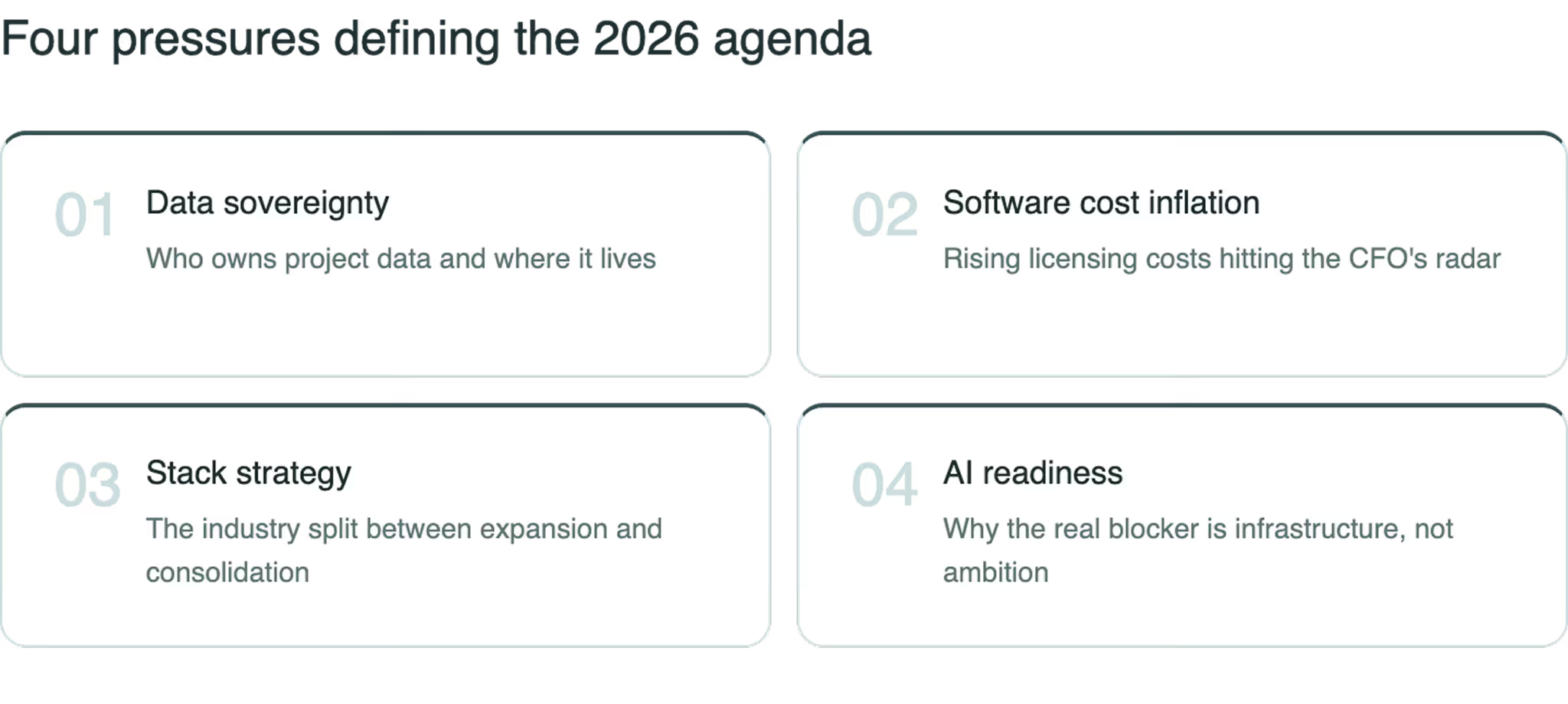
Together, these four are reshaping AEC digital transformation priorities, how CIOs are spending, and how they're preparing their organizations for what's next.
Pressure 1: Data sovereignty is now a boardroom issue
96% of the AEC CIOs surveyed said they are concerned about data ownership and control when selecting technology vendors. 38% described themselves as "very" or "extremely" concerned.
That near-universal response is a shift. Data ownership used to live in procurement contracts. Now it's on board-level risk registers.
The concern is strongest in Australia and Germany, where tighter regulatory environments and heightened sensitivity to vendor lock-in have pushed the issue to the top of the agenda. The message to vendors is clear: CIOs are no longer just buying functionality. They are buying sovereignty over their own project intelligence.
For anyone responsible for construction software implementation, this changes vendor evaluation. "Where is this hosted, and who ultimately controls it?" is now one of the first questions, not one of the last. And the answers are reshaping which platforms get shortlisted.
Pressure 2: Software costs are climbing — and finance has noticed
66% of CIOs surveyed reported increased software and cloud licensing costs over the last twelve months:
This isn't a quiet trend. It's a line item visible at CFO level, and it's translating into pressure on CIOs to justify, rationalize, and where possible reduce spend.
The complication is that it's happening at exactly the moment digital ambition is rising. Firms want more from their technology — better coordination, cleaner data, AI readiness — while paying less per seat than they were two years ago.
That tension is what's driving the next pressure, and arguably the most consequential.
Pressure 3: The construction tech stack is splitting nearly down the middle
The industry is almost evenly divided on stack strategy for the next 12–18 months:
That isn't confusion. It's firms making genuinely different strategic bets based on where they sit on the digital maturity curve. Firms earlier in their digital journey are still adding capability. Firms that have been buying for a decade are now looking at stacks that have become unwieldy, expensive, and full of overlap.
The single most common move, though, is consolidation. 31% of CIOs plan to consolidate by up to 25% — the largest single response in the dataset. The consolidation-first cohort is asking a specific question: what can we remove from the stack without losing capability? And the answer is increasingly more than we thought. Overlapping point tools, legacy systems kept on life support, integrations built for yesterday's workflow — all of it is coming under review.
Stack consolidation also connects directly back to the construction technology adoption challenge explored in Chapter 2 of the report. Fewer, better-connected tools reduce the training load on teams — which is the single biggest factor holding back adoption. The end goal is connected project intelligence: a platform layer where coordination, data, and decisions sit together rather than scattered across disconnected systems.

Pressure 4: AI readiness is a data-foundations problem
The AI conversation has moved from "should we?" to "can we?" — and the 2026 data shows where the real blockers sit. The top four barriers to AI value cited by AEC CIOs:
Integrations and data foundations together account for 32% of all AI adoption barriers — the largest combined category.
That reframes AI as an infrastructure problem, not an ambition one.
"The most successful AI implementations that we're seeing right now are ones that are hyper focused, as opposed to those trying to boil the ocean and have AI sit over the top of everything like it's this magic button. That's where you start to build credibility: at the task level."
David Felker, CIO, Trilon Group
"Regulatory concern and skills gaps become more manageable when AI is embedded inside the tools teams already use rather than bolted on as a separate layer. The skills barrier shrinks when people can just ask questions about their model without switching context."
Jaime Alonso, Candau Director, nonica.io
The pattern is consistent. The firms that will deploy AI meaningfully in 2027 are the ones spending 2026 on three things:
- Cleaning up the data layer — consolidating sources of truth and improving data quality
- Tightening integrations — so tools share context rather than duplicate it
- Narrowing the use case scope — focused, task-level AI where credibility can actually be built
The digital skills gap in construction becomes significantly easier to close when AI operates inside familiar tools, rather than requiring staff to learn a separate layer on top. This is the thinking behind Revizto AI — intelligence embedded inside the coordination environment teams already use, rather than positioned as a separate product to learn and govern.
What a consolidation-first strategy actually looks like
"The next phase of digital transformation will not be driven by buying more technology, but by better connecting the tools we have to create a single, undeniable source of truth."
Arman Gukasyan, Founder and CEO, Revizto
That's the CIO mandate in 2026. It's no longer about what to buy. It's about what to connect, what to cut, and who actually owns the data underneath it all.
FAQs
The 2026 Bridging the Gap report surveyed 600 AEC CIOs and found four dominant pressures: data sovereignty (96% concerned about data ownership when selecting vendors), rising software costs (66% reporting increases in the last 12 months), stack strategy decisions (41% expanding vs 39% consolidating), and AI readiness (with integration and data foundation issues accounting for 32% of AI adoption barriers). Together these define a mandate that has moved beyond "invest in technology" to "connect, rationalize, and govern it."
As projects generate larger volumes of valuable data, CIOs are increasingly focused on who controls that data, where it's hosted, and how accessible it remains long-term. 96% of AEC CIOs report being concerned about data ownership when selecting vendors, with 38% "very" or "extremely" concerned. The concern is strongest in Australia and Germany, reflecting tighter regulatory environments and heightened sensitivity to vendor lock-in. Data sovereignty has become a board-level risk topic, not just a procurement clause.
The industry is nearly evenly split. 41% of CIOs plan to expand their stack in the next 12–18 months, while 39% plan to consolidate. The single most common move is consolidating by up to 25%, cited by 31% of CIOs — making it the largest response in the dataset. Most consolidation is motivated by rising licensing costs and the recognition that fewer, better-connected tools reduce adoption friction across teams.
The top four barriers cited by AEC CIOs in the 2026 data are regulatory concerns (24%), limited digital skills (23%), lack of integrations (17%), and poor data foundations (15%). Integrations and data foundations together represent 32% of all barriers — the largest combined category. This suggests AI readiness is primarily an infrastructure problem, not an ambition or investment problem. The firms most likely to deploy AI meaningfully in 2027 are those spending 2026 on data layer cleanup, tighter integrations, and focused, task-level AI use cases.
66% of AEC CIOs reported increased software and cloud licensing costs over the last 12 months. 49% reported increases of 1–10%, and 17% reported increases of 11–25%. Multi-disciplinary engineering firms were the most likely to report double-digit increases. This cost inflation is a primary driver of the current push toward stack consolidation.
Three reasons, according to the 2026 data. First, rising licensing costs are creating pressure to rationalize spend. Second, overlapping point tools create integration overhead that eats into team productivity. Third, fewer, better-connected platforms reduce the adoption friction that holds back construction technology adoption across the wider team — especially the time barrier that 32% of AEC professionals cite as the biggest blocker.