The $13 trillion opportunity: Why accessible data is the next frontier for construction
See how Revizto fits your workflow
In the $13 trillion construction industry, traditional BIM tools lock out 97% of project teams. Revizto solves this data gap with an intuitive visual environment, giving field teams, owners, and specialists instant access to real-time project data.
My early career wasn’t in traditional engineering; it wasin 3D GIS mapping. While visualizing global cities like London and Dubai for local governments, I watched a group of city leaders huddled around a physical map of the city. It was a great demonstration of collaboration, but it highlighted a clear gap: these teams wanted to work closely, yet they were relying on a static physical mockup because the rich digital project data was locked away in complex backend software.
That moment sparked a practical question: How do we give that spirit of teamwork a digital home? I launched Revizto in 2012 to answer that, building an interface that brings complex design data directly to the people on the ground. Today, connecting teams with their data remains our core mission.
A $13 trillion industry that still runs on fragments
Construction is one of the largest industries in the world today, valued at roughly $13 trillion and headed toward $22 trillion over the next decade as infrastructure development and data center spending accelerate. And yet, it historically remains one of the least digitized major industries on the planet, outpaced by nearly every other global sector.
That's not a contradiction. It's the reason operational gaps and administrative friction continue to persist across complex builds.
Why does an industry this large stay this undigitized? Because the tools built for it were built by specialists, for specialists. They assume a level of technical fluency that most of the people who need the data simply don't have—and don't have time to acquire. Look at who can actually open a native authoring file and interpret it in any depth. It's a small fraction of the people working on a given project.
Everyone else—the field teams, the owners, the facilities staff who will run the building for the next thirty years—is working from fragments: a flat PDF, a static printout, or a summary secondhand from someone who happens to have software access.
The workforce gap makes this worse, not better
The US construction industry faces a severe labor shortage, measured in hundreds of thousands of open positions. You cannot solve a talent shortage of that scale by making project software harder to learn. You solve it by making the software intuitive enough that someone can pick it up in under half an hour and start contributing on day one, regardless of what tool created the underlying model.
What is the 3% problem? On a typical major build, only 2% to 3% of the project team can actually navigate traditional BIM authoring tools. The remaining 97% are left locked out of the core data they need to execute their jobs cleanly.
That's the core design principle we've built Revizto around since the beginning: take a data set as complex as a BIM model or a point cloud and make it navigable by absolutely anyone on a project, not just the isolated few trained on specialized authoring tools.
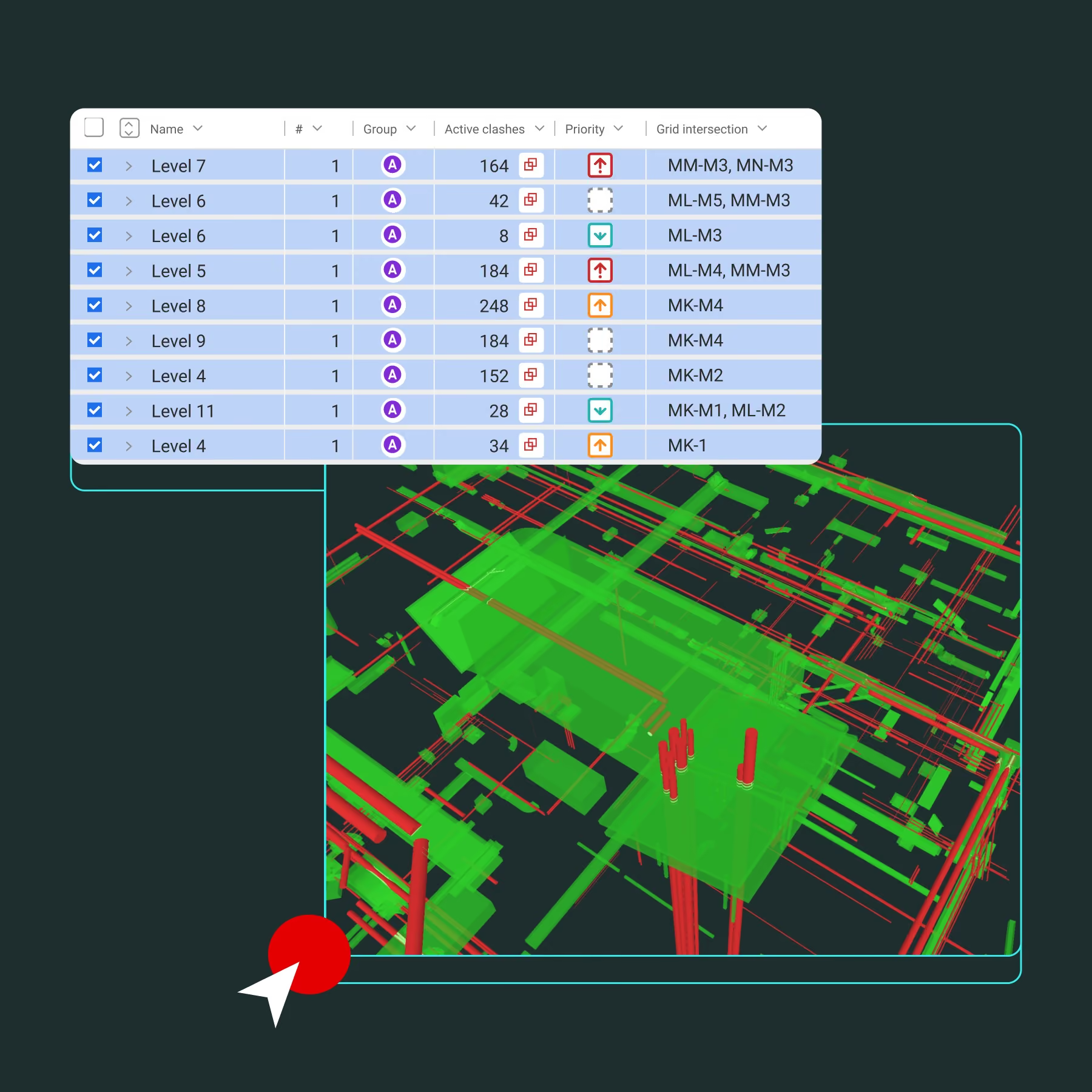
How to achieve true data democratization in AEC
Digitizing construction isn't about adding more software to the pile. The industry has plenty of software. It's about making the data inside that software accessible to the people who are actually supposed to act on it: the superintendent walking the job site, the owner's rep reviewing progress, the facilities manager inheriting the building.
Closing the digitization gap requires fewer closed systems and more shared access. It takes tools that operate seamlessly regardless of which authoring platform generated the model, and user interfaces built specifically for the person who has never opened a BIM tool before.
The coordination barriers, the communication gaps, the avoidable rework—none of it is an unsolvable mystery. It comes from the same root cause every time: information exists, but the people who need it to make a decision can't get to it fast enough, or at all.
If your team is still working from fragmented printouts and isolated data silos, that is exactly the structural problem Revizto was built to solve. Bring your existing tools and see how simple true cross-platform collaboration can be.
See a product walkthrough to discover how Revizto unifies your data and empowers 100% of your project team to build from the same source of truth.

FAQs
Construction software has historically been built for a small group of technically trained specialists rather than the full range of people working on a project. This leaves most field teams, owners, and facilities staff working from incomplete or secondhand information rather than direct access to project data.
Software that works across authoring platforms, requires minimal training to get started, and gives non-technical project stakeholders direct access to project data helps close the gap between the small number of people who can interpret raw project data and the much larger group who need to act on it.