What university classrooms reveal about the construction skills gap
See how Revizto fits your workflow
AECO firms and universities face the same challenge: rapid tech evolution outpacing training. By prioritizing core construction concepts over rigid software mechanics, intuitive visual tools like Revizto bridge the skills gap, attract new talent, and connect digitally native graduates with field veterans.
During a week spent with university faculty gathered at the Associated Schools of Construction annual conference this past April at Cal Poly San Luis Obispo, I listened to them describe an academic environment where the goalposts move every single day. The market demand for highly skilled talent is at an all-time high. Yet, the foundational concepts, methods, and tools they rely on are evolving faster than training programs can handle. Every time educators try to establish a uniform standard, those frameworks shift.
To make matters more complicated, these programs must prepare students for a future heavily influenced by rapidly emerging technology. However, nobody can definitively say what that future will look like in a few years. On top of it all, classroom instruction time is strictly limited, and resources are stretched thin.
Sound familiar?
As it turns out, the worrying effects of this massive skills gap and technology confusion looming over the AECO industry are just as recognizable to the leading minds in Construction Management (CM) education as they are to an executive roundtable.
A moving target: keeping operations and classrooms synced with field demands
Right now, the pressures the construction industry faces trickle directly down to universities. Industry demand for graduates who are completely work-ready is skyrocketing. In turn, this puts immense pressure on CM programs. Educators must ensure that their curriculum is as up-to-date as humanly possible while fighting to keep student enrollments climbing.
Keeping a multi-year university curriculum synchronized with modern field demands is an uphill battle. This is because concepts, methods, and technology are all evolving at an unprecedented pace.
This gap is propelled by an aging workforce with a massive wave of veteran retirements taking institutional knowledge with them.
Three primary challenges emerged during conference discussions:
1. The standards void. True industry standards either are not truly standardized or they change too quickly to integrate into a syllabus. Frameworks like ISO 19650 are a great start. However, academia is still looking for a definitive leader to standardize curriculum.
2. Enterprise scaling. Committing to a software platform at an enterprise level carries massive risk when technology outpaces the deployment cycle. By the time an organization normalizes a tool across every team, the underlying technology shifts. This leaves them locked into a rigid system and perfectly mirrors a university trying to anchor a multi-year syllabus to a single piece of software.
3. The AI dilemma. Artificial intelligence is a perfect example of this moving target. How do you prepare a student for the future of construction when we’re not exactly sure how it will look when they graduate? Even though AI was a hot topic, and this is the only time it will be mentioned here. There was some great discussion, but the net takeaway about what this decisively means at the moment is mostly a collective ¯\(ツ)/¯. The ASC will be hosting future events discussing more tangible AI ramifications.
This rapid technological acceleration, compounded by the organizational friction of enterprise scaling, has created a distinct disconnect in the industry as well. When tools like drones, AI, and modern methods of construction outpace both formal training and corporate deployment cycles, everyone loses. This forces tradespeople to self-teach new tech while organizations risk getting locked into rigid platforms and ultimately driving severe project delays, inflated labor costs, and failed deployments.
Concepts over clicks: teaching thinking, not just software
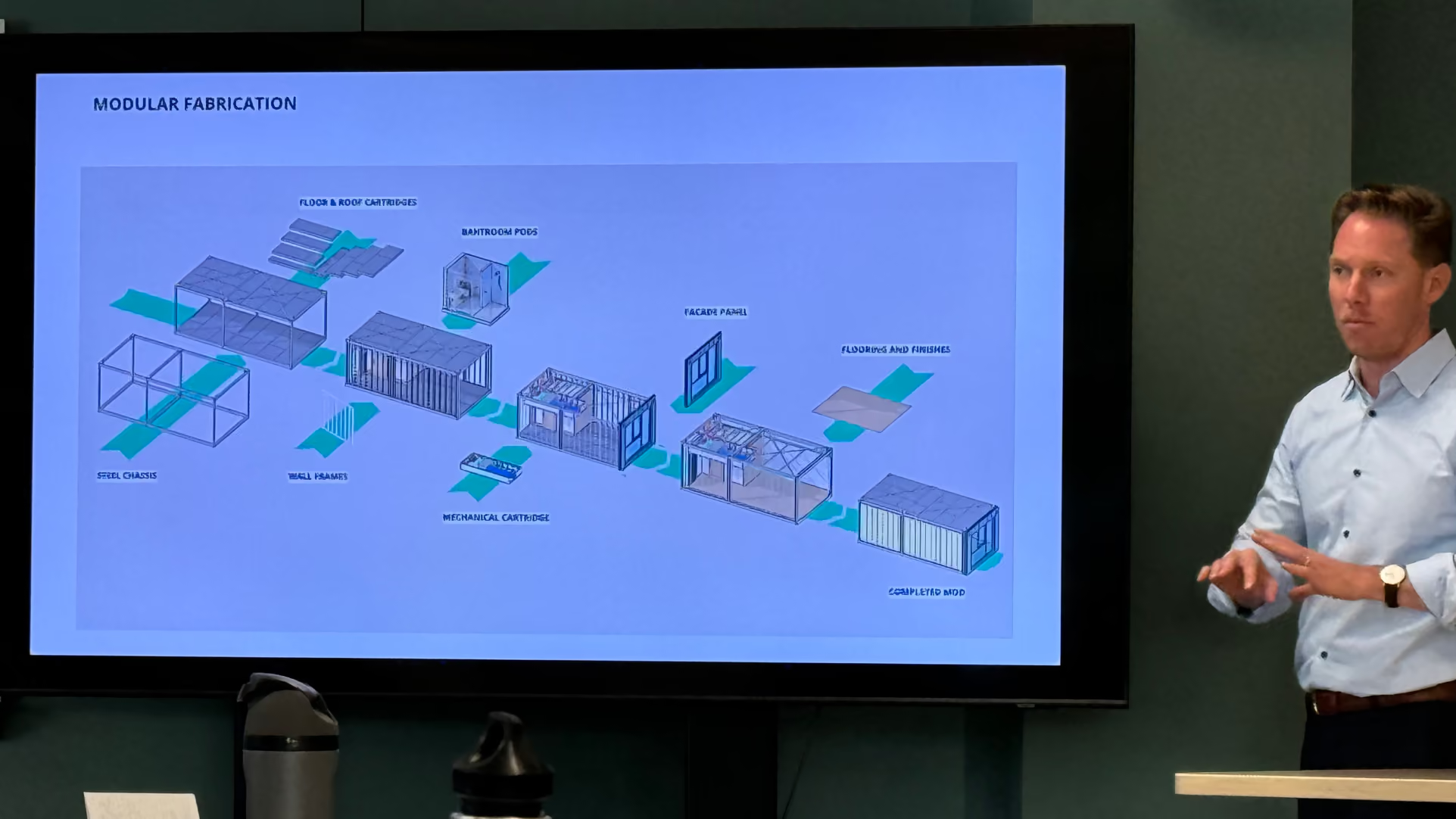
Because classroom time is strictly limited, professors are holding a firm line: concepts must be taught, not software. A university classroom cannot just become a button-clicking tutorial for a specific piece of tech. It must offer stability as a foundational tool that furthers core learning outcomes.
Interestingly, the industry shares this exact perspective. Tools should always be secondary; possessing the foundational skills, critical thinking, and domain knowledge is what is most important. If a graduate thoroughly understands why a coordination process works conceptually, they can successfully adapt to whatever software platform an employer throws at them.
At its core, Revizto simplifies this massive, existential skills gap by shifting the focus from complex software mechanics to intuitive visual collaboration. Instead of forcing teams to learn how to click buttons in a maze of heavy CAD programs, Revizto acts as a translator.
Using BIM and VDC to solve the talent deficit
Students are the lifeblood of CM programs, just as graduates are the lifeblood of the industry. Currently, the construction talent pool is severely limited by a lack of diversity; construction remains highly homogenous, with women accounting for only about 10% of the workforce.
This is where accessible tech offers an appealing solution. BIM/VDC technology makes CM programs significantly more attractive to the next generation. It serves as a key mechanism for attracting students who might have previously never considered construction as a viable career path.
By leaning into BIM and adopting Revizto, programs are:
- Boosting enrollment and recruitment: Traditional construction can feel closed-off or intimidating to outsiders, but immersive, game-like 3D environments make CM programs and AEC careers highly attractive to a broader, digitally native demographic. By making the technology accessible and exciting, Revizto helps university CM programs and enterprise recruiters attract talent that previously never would have considered a career in construction.
- Transforming education: Revizto is built to be highly visual and user-friendly, stripping away the technical intimidation of traditional BIM software. Because it operates like a navigable 3D environment, field teams can easily grasp model coordination without needing a degree in computer science. It lowers the technology literacy floor, meaning faster onboarding and drastically fewer failed software deployments.
- Remaining agile: Adopting Revizto allows both CM programs and construction firms to stay agile because it focuses on core communication workflows rather than rigid software features. When new innovations inevitably disrupt the market, teams don't have to completely relearn their processes from scratch. Revizto is constantly evolving to incorporate larger and more diversified model formats, ensuring that both students and field professionals can easily adapt as the jobsite landscape continues to shift.
Closing the loop: the industry career pivot
The relationship between academia and industry shouldn't end at graduation. The construction industry is facing a massive wave of veteran retirements, taking decades of institutional knowledge with them.
To combat this, BIM/VDC gives experienced construction professionals an excellent optional career pivot as the physical demands of field roles take their toll. However, the industry must be prepared to enable these pivots by actively providing robust internal education to their field professionals.
This is exactly where platforms like Revizto step in to bridge the academic and practical worlds:
- Immersive Training: Revizto Academy serves as a powerful component in corporate training because it opens up the platform as an immersive, accessible way to learn.
- Visual Mentorship: Revizto effectively becomes the training tool itself. It functions as a highly visual method of mentoring and creates a common language between tech-savvy new graduates and seasoned field veterans.
- Low Barrier to Entry: Even a Revizto Level 1 certification will equip a new user with enough baseline operational confidence to tap into the massive collaborative power of BIM.
- Continued Growth: Revizto Academy content is constantly growing to meet the demands of the industry.

From books to buildings
The similarities between academic hurdles and industry headaches are shockingly similar. Whether you are a professor trying to build a syllabus or a CIO trying to build an innovation roadmap, the challenge is the same: balancing foundational concepts with rapidly changing tools. By focusing on core workflows, scaling internal education, and using highly visual tools to establish a common language, we can close the skills gap together; from the classroom to the jobsite.
Taking the next step
- For our commercial partners: Eliminate costly project delays and empower your field teams with an intuitive visual collaboration platform. Learn how to streamline your workflows, maximize your productivity, and protect your data ownership. Book a commercial demo
- For university instructors: Sync your classroom with modern field demands and give your students a competitive edge. Attract a diverse pool of talent to your program and teach core construction concepts through immersive 3D environments. Book an academic demo
- For professionals and field teams: Learn at your own pace and build immediate operational confidence. Upskill your workforce, bridge the generational technology gap, and earn your Level 1 certification. Start learning at Revizto Academy
- While you’re here: Download the full Bridging the Gap Report 2026 to discover actionable, data-backed insights on how to build a resilient workforce.
Post script:
The Associated Schools of Construction (ASC) serves as the premier global organization for the development and advancement of construction education, bringing together forward-thinking university faculty and industry leaders to shape the future of the built environment. By fostering a collaborative ecosystem where academic curricula can adapt to rapid technological shifts, the ASC plays a vital role in preparing the next generation of work-ready construction professionals. Everyone at Revizto would like to extend a sincere thank you to the Associated Schools of Construction for welcoming us and allowing us to continue to be a strong, dedicated partner in bridging the gap between the classroom and the jobsite. Learn more here.

FAQs
The talent deficit acts as a severe economic bottleneck across the industry. A lack of technical expertise causes contractors to experience significant project delays and inflated labor costs. In many cases, firms must actively turn down new, profitable contracts simply because they do not have the staff to execute them.
Technology adoption moves much faster than corporate deployment cycles and university syllabi. This disconnect forces tradespeople to self-teach new tech tools on the job. When field teams are left to figure out complex software on their own, organizations risk getting locked into rigid platforms, driving operational friction and failed rollouts.
Advanced technology expands the recruitment pipeline by appealing to a younger, digitally native demographic. This accessibility is vital since the workforce remains highly homogenous, with women making up only 10% of the total workforce. An intuitive BIM coordination platform like Revizto lowers the technical learning barrier. Through tools like Revizto Academy, new graduates and seasoned field veterans can build a common language, streamline onboarding, and eliminate failed software deployments.