Your construction data is yours. The Revizto API is how you use it.
See how Revizto fits your workflow
In our most recent industry report, 96% of CIOs told us they were concerned about who owns their data. That number didn't surprise me. What surprised me was how often the concern stops there, as a worry rather than a decision.
Data ownership in construction isn't just about where your files are stored. It's about what you can actually do with your data: whether you can extract it, move it, analyze it, and connect it to the tools that drive decisions in your business. A platform that holds your data but doesn't let you use it freely isn't giving you ownership. It's giving you access.
That distinction is what the Revizto API is built on. In this article, I will explain what it does, how real teams are using it, and why it matters specifically for construction organizations who want genuine control over their project data.
Your application is the customer. The Revizto server is the kitchen.
What is an API?
API stands for Application Programming Interface. At its simplest, an API is a set of rules that allows one piece of software to talk to another. Most of the digital tools you use every day rely on APIs working quietly in the background: when a weather app pulls a forecast, when a payment system processes a transaction, or when a project management tool syncs with your calendar, an API is handling that exchange.
In the context of Revizto, the API gives you a way to interact with the platform programmatically rather than through the graphical interface. Instead of clicking through menus, you send structured requests over the web to get data out of Revizto, push data in, or trigger actions.
Think of it like a restaurant. Your custom application is the customer. The Revizto server is the kitchen. The API is the waiter: it takes your order, communicates with the kitchen, and brings back exactly what you asked for. The menu is fixed (there are specific endpoints for specific types of data), but within that menu, you have a lot of flexibility.
What this means in practice is that repetitive tasks you currently do by hand in Revizto, including adding users, creating issues, and exporting clash data, can potentially be automated. Data you want to analyze can be extracted and fed into the tools your business already uses. And any platform that has its own API can, in principle, be connected to Revizto so that data flows between them.
Stop clicking. Start automating.
One of the use cases I find most compelling comes from Nathan Beplate at John Holland Group. Nathan built a mobile application that manages Revizto users entirely through the API: inviting new users, offboarding existing ones, and adjusting project roles, all without touching the Revizto interface. Tasks that previously took multiple steps and manual navigation now happen from his phone.
Nathan also built a tool that creates Revizto issues directly from geotagged photos taken on-site. On large infrastructure projects, it can be difficult to know exactly where you are standing relative to the model. His tool extracts the GPS coordinates from the photo metadata, converts them to project coordinates, and creates an issue in the correct location in the model automatically, with the photo attached and the street address added as a comment. What used to require careful navigation through 2D drawings and 3D models now takes one photo.
At Revizto, we've built two similar tools that are available free to customers through your industry consultant: one that creates issues from a CSV file (useful when migrating issues from external platforms), and one that bulk-creates issues from a folder of geotagged photos.
"The API allows you to take something repetitive and turn it into something that runs itself. That's time back on every project, indefinitely."
Ahmed Abdelmeguid, Industry Consultant, Revizto
Your data, wherever decisions get made
The API becomes especially powerful when you use it to build integrations between Revizto and the other platforms your teams are working in.
Daniel Šmejkal at Prague Airport built an integration that takes the results of Autodesk's Model Checker for Revit. These are the quality checks run against a model before it's published, and his tool recreates them as issues directly in the Revizto issue tracker. His custom application, modelRevizor, loads the exported Excel file from the model checker, lets the team filter and prepare the results, bulk-add comments, assign issues to model authors, and then send them all to Revizto in a single operation. It removed a manual re-entry step that would otherwise have required someone to create those issues one by one.
What makes this approach powerful is that the team isn't locked into Revizto's native interface to understand what's happening on their project. They've taken their data and put it where their workflows already live.
Dashboards built around how you work, not how the platform works
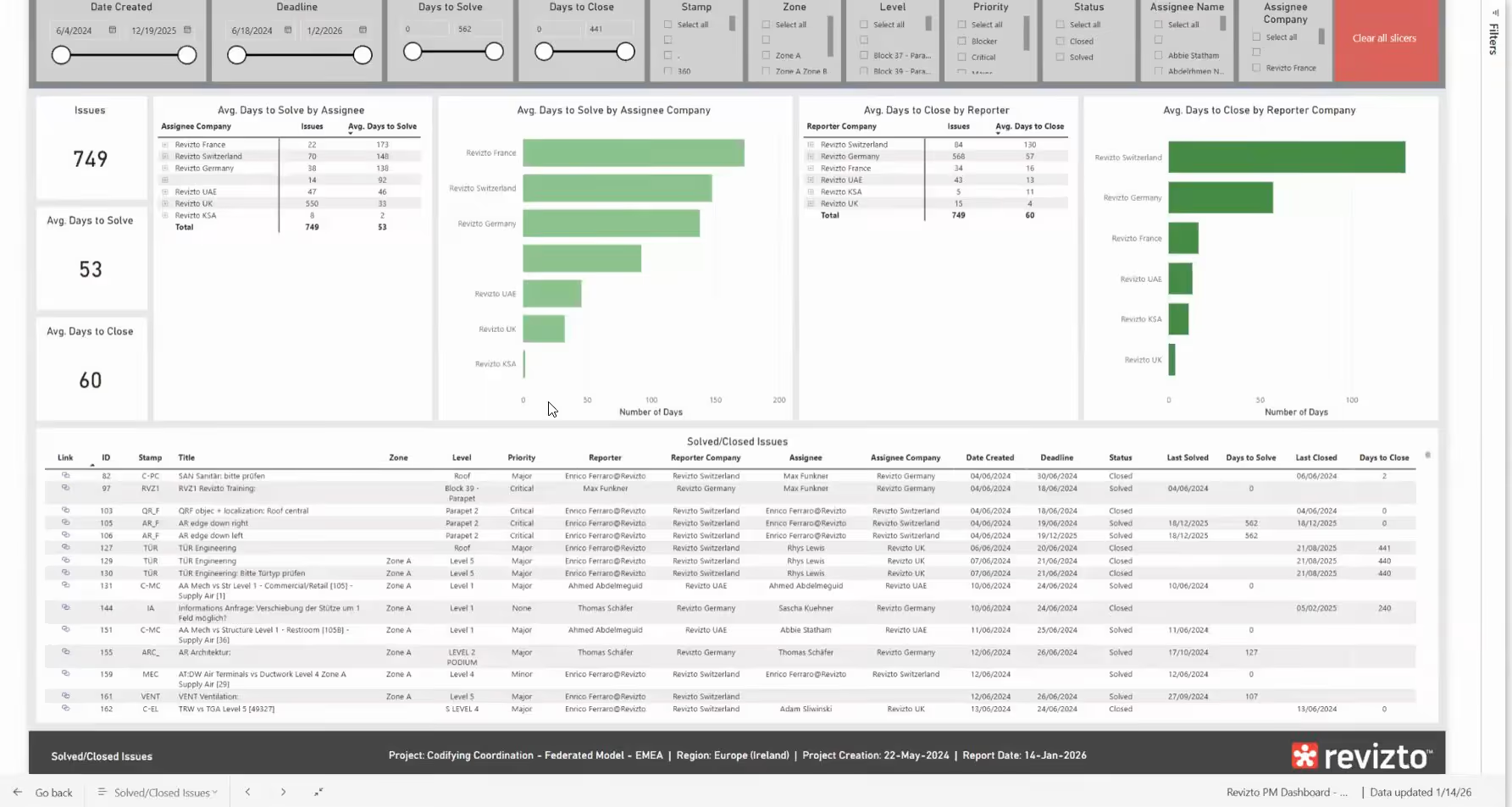
When you can query your own issue data, you can visualize it however your team actually thinks. Nathan built heat maps that show the concentration of issues across project areas, broken down by package. These are visual tools that are impossible to replicate inside a standard issue tracker, and that become genuinely useful during coordination reviews.
The common thread here is to secure access to your own data. The Revizto API uses role-based permissions. Your API access mirrors exactly what your project role allows. Data flows out only to systems and users who are authorized to see it. That's a meaningful part of what it means to run a secure BIM collaboration platform: not just protecting data from external threats, but giving organizations clear, auditable control over how their data moves internally.
On the roadmap: your model data, fully accessible
This summer, we're releasing endpoints for model metadata and object metadata. The model metadata endpoints will give you programmatic access to the list of 3D models in Revizto, who published them, when, and any custom properties attached. The object metadata endpoints go further, giving you access to the properties attached to individual objects in the model, including quantities, classification data, and any custom attributes your team has applied.
The use cases this opens up include quantity takeoffs fed directly to cost estimation tools, asset data flowing to facility management systems, and construction progress tracking built on object-level status attributes. These endpoints are currently in beta and will be generally available this summer.
We're also planning an MCP server, announced at our Made Right 2026 conference, that will allow teams to connect any AI agent to the Revizto API through a natural language interface. Rather than writing API requests, you write prompts, and the MCP server handles the translation. That should lower the barrier for teams who want the benefits of the API without needing to build custom code.
"The question I hear most often is: 'Can I get my data out of Revizto and into the tools I already use?' The answer has always been yes. What we're doing now is making it easier."
Ahmed Abdelmeguid, Industry Consultant, Revizto
You don't need to be a developer to start
If you've never used the API before, the best starting point is the API Essentials course at academy.revizto.com. It's free, requires no prior coding experience, and walks you through authentication, GET and POST requests, and your first integrations. We've had customers with no development background complete this course and go on to build the kinds of tools I've described above.
If you're already working in Python, there's a third-party library called PyRevizto, that simplifies the number of lines of code required to interact with the API.
To see everything I've covered in this article, including live demos of the use cases from Nathan and Daniel, the full webinar is available to watch here.
Construction data security and data ownership aren't abstract concerns. They're operational ones. The teams who are getting the most out of Revizto aren't just using the platform; they're connecting it to the rest of how they work. The API is how you do that.
Want to explore what the Revizto API can do for your team? Talk to us today.

FAQs
Construction data ownership refers to an organization's ability to access, extract, move, and use its own project data without restriction. In practice, it means being able to take your issue data, clash results, model metadata, and coordination history out of any platform and use it in the tools that drive decisions in your business. It matters because data that can't be extracted or integrated effectively becomes siloed: valuable in one interface but inaccessible to the rest of your workflows.
The Revizto API gives teams programmatic access to their project data through structured requests, allowing them to extract issues, clashes, 2D sheet metadata, user information, and, from this summer, model and object metadata. Because access is governed by existing project role permissions, teams control exactly what data each user or application can access and extract. Data stays within your authorized systems; nothing flows outside the permissions you've already defined.
Yes. Revizto holds industry-standard security certifications confirming robust data controls are in place. The platform supports local data hosting — meaning your project data is stored in your specified region or jurisdiction via Revizto's cloud infrastructure. API access inherits the same role-based permission structure as the platform itself, so programmatic data access is subject to the same security controls as any other user interaction.
The three main categories are automation tools (creating or updating issues at scale, managing users programmatically, bulk-importing data from external sources), integrations (connecting Revizto to GIS systems, model checkers, project management platforms, or any tool with its own API), and custom dashboards (extracting issue and clash data into Power BI, custom web applications, or any business intelligence tool your organization uses). The upcoming model and object metadata endpoints will extend this further to include information such as quantity data, construction status, and object-level properties.
Some coding knowledge helps, but it isn't a strict requirement. Revizto Academy offers a free API Essentials course that starts from first principles, with no prior development experience needed. For teams already using low-code automation tools like Microsoft Power Automate or n8n, the API can be accessed through HTTP request steps without writing custom code. The Python library pyRevizto also reduces the amount of code required for Python-based workflows.
The best starting point is the API Essentials course at academy.revizto.com, which is free and available to any user with an active Revizto license. To test endpoints before building, Postman is a widely used tool that lets you send individual GET and POST requests and inspect the responses. Every Revizto user can access the API on the projects they have permission to work on; there's no separate sandbox environment required.