Platform vs. ecosystem: Why I built Revizto to be an open BIM platform
See how Revizto fits your workflow
Revizto Founder and CEO Arman Gukasyan outlines why the company rejects closed-wall software in favor of an open BIM platform. Driven by a "Bring Your Own Workflow" (BYOW) philosophy, Revizto unifies data from any authoring tool (like Revit or Tekla) and partner applications into a single environment without forcing teams to alter their processes.
At Revizto, we made a conscious, strategic decision early on: we would build the absolute best coordination and collaboration layer in the world, rather than trying to build a mediocre version of everything else.
Some software companies try to build a closed wall around a project, forcing teams to use their proprietary authoring tools, issue trackers, and scheduling systems. But the AEC industry is too vast and fragmented for a closed-platform approach to work efficiently. We chose a different path - one that prioritizes maximum data integration over vendor lock-in.
The problem with closed AEC software
When we started building what would become Revizto, I made a decision that shaped everything that came after: we would never ask a team to change how they create their data in order to use us. It doesn't matter whether a model was built in Revit, Tekla, Bentley, or ArchiCAD. It doesn't matter whether the data started as a point cloud, a real-time capture, or a set of sheets. Revizto's job is to unite it, not to compete with it.
What's the risk of a closed AEC platform? It forces project teams to make a trade-off that has nothing to do with the work: keep using the tool that fits your workflow, or get the coordination features that fit your project. That's a false choice, and it's one project teams shouldn't have to make.
From gaming tech to open ecosystems
As I discussed in a recent interview on the AEC Tech Journeys podcast, we deliberately built Revizto utilizing 3D gaming engine frameworks to handle the optimization of massive, data-heavy project environments. Today, our engine processes mega-projects and is capable of handling files as large as 350 gigabytes.
Because we built a powerful coordination and optimization layer rather than an authoritarian application, we can afford to stay completely agnostic. Our goal is simple interface accessibility: allowing everyone, from field engineers at every stage of their careers to hospital nurses and owners, to navigate complex project data within 30 minutes of getting started.
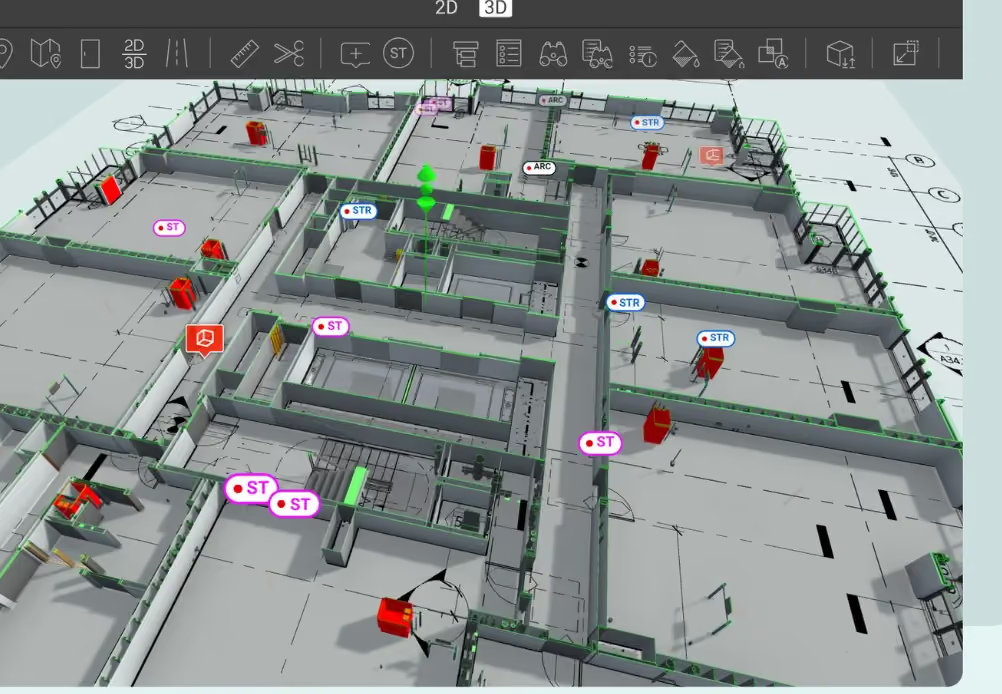
Bring your own workflow, not our workflow
This is the thinking behind what we call Bring Your Own Workflow (BYOW). Wherever your data is created, and whatever issue tracking or project management system your company already runs on, Revizto is built to align with it rather than replace it. If your team already manages tickets in one system and documentation in another, that's not a problem for us to solve by asking you to switch. It's a problem we solve by connecting.
That's also why we've spent real effort on partnerships with tools like OpenSpace and Cupix, and why we've formalized a partner program to make that kind of collaboration more structured rather than ad-hoc. The goal isn't to add logos to a page. It's to make sure that when a project team has already invested in a tool that does one part of the job well, Revizto works with it instead of around it.
Why openness is a harder business decision
Why not just build a closed ecosystem and capture more of the workflow? Because it would work against the reason teams choose Revizto in the first place. Every company in this industry has its own core competencies. It's not our place to decide that our issue tracker or scheduling tool is automatically the right answer for every team on every project.
The harder, and in my view more honest, path is to stay platform-agnostic: build the best BIM coordination and collaboration layer we can, and let it sit on top of whatever tech stack a team has already chosen. That means competing on whether the product actually solves problems, not on whether a team is locked into a proprietary contract.
Openness as the foundation for AI and data sovereignty
This same principle is why we've been opening up our API and why data sovereignty matters so much to how we're approaching AI. An open platform isn't just about which authoring tools we support today. It's about making sure a project team's data, workflows, and choice of tools remain theirs to control, now and as the technologies driving this industry keep changing.
Take control of your project data
You shouldn’t have to compromise your workflow just to achieve cross-team collaboration. If you are ready to eliminate information silos, optimize your BIM coordination, and experience true platform agnosticism, let’s talk about how Revizto can unify your existing tech stack. Schedule a personalized demo with the Revizto team today to see our open ecosystem approach in action.

FAQs
A platform approach tries to handle every part of a workflow inside one closed system, often requiring teams to change how they work to fit the tool. An ecosystem approach connects to the tools a team already uses, including authoring software, issue tracking, and project management systems, without requiring them to switch.
Bring Your Own Workflow is Revizto's approach to staying platform-agnostic. It means teams can continue using the authoring tools, issue tracking systems, and project management processes they already have in place, while Revizto connects and unifies that data rather than requiring a switch to a new workflow.