BIM trends in 2026: what's changing in the industry
See how Revizto fits your workflow
Building information modeling (BIM) is an extremely powerful technology that completely changes the way construction projects are managed and monitored. It can be difficult to work with, but its advantages are well worth the effort. This article discusses the best-known trends in BIM at this time, while also debating what could be expected from it in the future.
The BIM trends shaping 2026 are AI assistants that work with project data, MCP connections between AI tools and BIM platforms, automated clash triage, openBIM standards (IFC 4.3, IDS and bSDD), and wider BIM mandates. Below, we explain what is new in each and who it affects.
What BIM is and why trends matter
Building information modeling (BIM) is a way of managing construction projects around a shared digital model and the information attached to it. Its core idea is a central project model that acts as a common data environment, so every participant can reach the same project data. BIM relies heavily on information technology, which changes fast, so new capabilities keep reaching BIM tools. This article covers the trends that matter most now. For the basics, read what BIM is, our guide to BIM in construction management, or the BIM fundamentals and standards content cluster.
The BIM market in 2026
Market research firms put the global BIM software market at roughly USD 10 to 11 billion in 2026. IMARC Group estimates USD 11.09 billion for 2026, growing to USD 12.82 billion in 2027. Estimates differ between firms because each defines the market differently, so treat these as ranges, not exact figures.
BIM trends in 2026
AI in BIM: assistants, MCP and clash triage
AI in BIM has moved from general talk to specific features in the tools teams already use. Information is the core of BIM, and AI helps with the work around it: searching and analyzing project data, and handling repetitive tasks. Three developments matter most in 2026. For a broader look at where AI helps and where it does not, read our guide to AI in BIM and construction technology.
AI assistants for models and project data. BIM and construction software vendors are adding assistants that let people ask questions in plain language instead of searching through models and issue lists by hand.
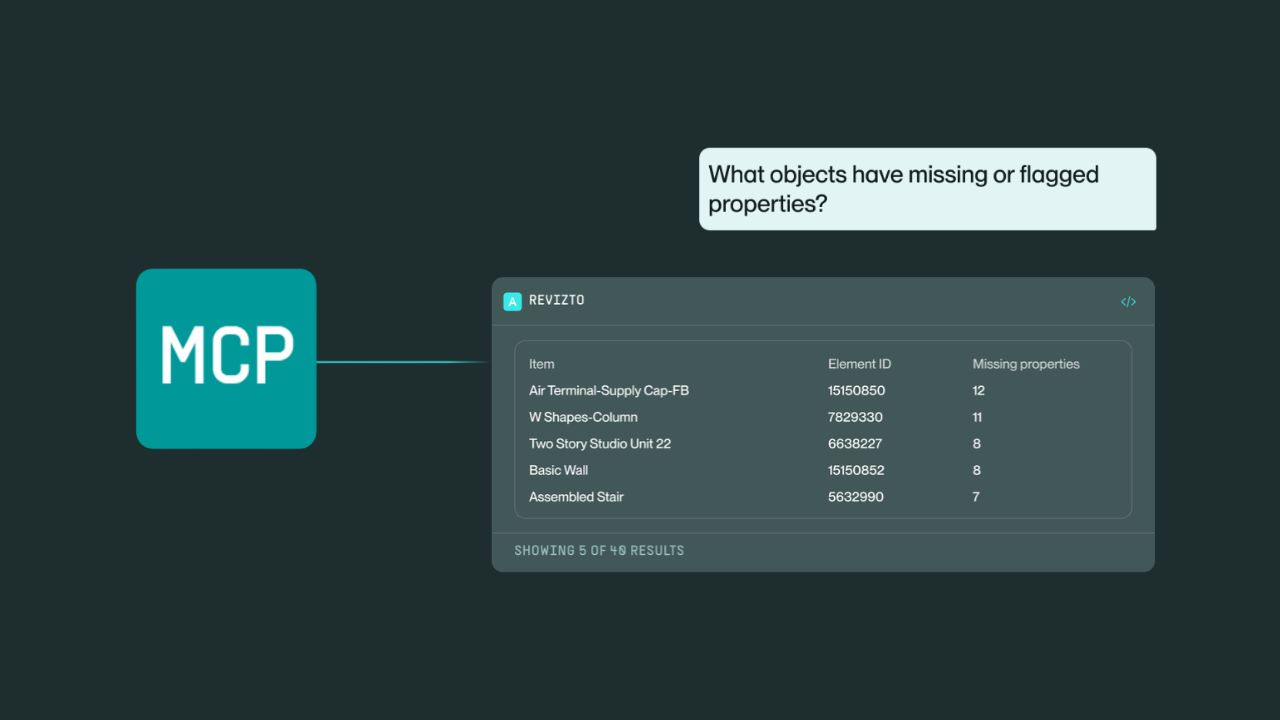
MCP access to project data. The Model Context Protocol (MCP) is an open way for AI tools to connect to other software. In BIM, it lets an AI assistant work with project data on a platform instead of with copies pasted into a chat. Revizto's MCP server is one example: it lets teams query project data in natural language, audit models, and analyze and triage issues, using the AI tool they already use. It respects each user's existing permissions, and write actions are review-based. To see how teams use it, read MCP, made practical: six real project workflows.
Automated clash triage. Clash detection on large federated models can produce hundreds of results. Automation reduces that work. With Revizto's Collaborative Clash Automation, teams set rules for scheduled clash tests, group hundreds of related clashes into one issue and create issues automatically. The rules are set by people, so coordinators stay in control of what gets raised and to whom.
Interoperability and openBIM standards: IFC 4.3, IDS and bSDD
One of the biggest issues in BIM is data sharing. The methodology allows seamless exchange, but the software market has produced many proprietary file formats with limited export and transformation options. That makes it hard for stakeholders to share information in some situations. Interoperability is the answer: a data format that different platforms can all work with.
The openBIM initiative from buildingSMART International is one of the best-known efforts here. A proprietary format that many tools support because of a vendor's market share is still proprietary, and open formats such as IFC avoid that limit. Three updates matter in 2026:
- IFC 4.3: The latest official version of Industry Foundation Classes is 4.3.2.0, commonly called IFC 4.3. It is also published by ISO as a final standard, ISO 16739-1:2024. buildingSMART is also developing IFC 5, a major refactoring of the format.
- IDS: Information Delivery Specification (IDS) defines information requirements in a form software can read, so IFC models can be checked automatically against them. IDS 1.0 was approved as an official buildingSMART standard on 1 June 2024.
- bSDD: The buildingSMART Data Dictionary is a free service that hosts connected data dictionaries with definitions of terms used to describe the built environment. Definitions from bSDD can be referenced in IFC models and IDS files. It is a service, not a standard.
In practice, IDS states what information a model must contain, bSDD provides shared definitions for those terms, and IFC carries the data between tools. For the standard that governs how project information is managed, see our guide to ISO 19650.
BIM mandates
BIM mandates are rules from governments or public clients that require projects to be designed and delivered with digital building models, often as part of public procurement. According to BIMobject's 2026 overview, BIM has been part of public project delivery in the UK and the Nordic countries for years, while parts of Europe and Latin America are phasing it into public procurement with clearer thresholds and timelines. Requirements differ by country, project size and client, so check the rules that apply to your project before you bid.
Digital twins
A BIM model is a digital representation of a structure that exists before the structure is built. A digital twin extends that idea: a digital model of an asset that stays linked to the real one. A detailed, scalable project model supports visualization for clients, simulation and better decisions during design and construction, and it can reduce rework.
Cloud-based BIM
Cloud-based BIM means storing and processing project information on remote servers instead of local machines. First, it makes project data accessible from anywhere, so teams are not tied to a single workstation. Second, cloud data sharing and processing let everyone work on the same platform, which improves communication and collaboration.
Modular construction and prefabrication
Prefabrication means manufacturing large construction elements off-site and assembling them after delivery. Modular construction is a variation of it: standardized complex elements built as modules and used on-site with little modification, such as factory-fitted bathrooms, dorm rooms and facade elements. Accurate project models help here because off-site parts must fit on-site, and fewer errors in the model mean fewer errors in construction.
Laser scanning
Laser scanning captures accurate on-site information, and BIM can receive and display it. In the "scan to BIM" process, scanners are set up on-site and their point-cloud data is converted into something BIM software can add to the project model. It reduces manual measuring and helps teams compare the model with what is actually built.
Drones
Drones are often grouped with laser scanning because both gather real-time data from construction sites. Drones can capture site information, support progress monitoring and help the site and the office stay in sync, including checking the locations of potential clashes or issues.
Sustainability
Sustainability in construction covers energy modeling, green architecture and related analysis. Energy analysis on a project model can evaluate parameters such as CO2 emissions, energy consumption and indoor environmental quality, and how a building would work with options such as solar panels. The goal is to reduce the building's impact on the environment.
Internet of things (IoT)
The Internet of things is a network of connected devices that share information. In construction, sensors can provide continuous monitoring of on-site structures and building systems. The data gathered can feed back into BIM, giving teams more information to work with during construction and, afterwards, during operation.
Virtual and augmented reality
VR and AR change how teams review designs and check for clashes by letting them look at a project in an immersive way instead of on a flat screen. They also help show clients the state of the project at different phases and collect feedback earlier. To see how this works in practice, read how to run a VR design review with Revizto and how to navigate a model in VR.
3D printing
3D printing builds physical shapes by laying down material layer by layer, driven by computer instructions. In construction, common uses so far are prototyping and creating scale models from digital models. How far it will go as a construction method is still open, so treat it as a trend to watch.
The future of BIM
BIM keeps developing alongside AI, open standards, cloud platforms, reality capture and prefabrication. Proper implementation takes investment and commitment from everyone on the project, including subcontractors and manufacturers. A practical way to start is to pick one workflow, measure the result, then expand. To keep learning, explore the BIM fundamentals and standards content cluster and read BIM vs CAD.
FAQs
MCP is the Model Context Protocol, an open way for AI tools to connect to other software. In BIM, it lets an AI assistant work with project data on a platform. See Revizto's MCP server.