We’re going to go back to where we started: information management, with a realistic view of AI
See how Revizto fits your workflow
Reflecting on 2026 and looking ahead to 2027, David Gomez, Enterprise Industry Consultant at Revizto, argues that the noise around AI in construction changes every year, and that the lasting work is deciding what information a business needs and how it is governed.
Ask me what is shifting in AECO and the answer is always AI. On LinkedIn, I see professionals sharing solutions that relieve a temporary pain, focused on their own tasks, at ground level on their own projects. They are practitioners solving real problems, but much of it is noise, because all of it can change within a year.
What helps me sleep a little better at night is a different question: where does AI need to come from?
AI should start from core business goals, not individual tasks
I think the answer starts at the core business level. Why are contractors in business? Why are design teams in business? Why does an owner want a building, and why do they want to work with the team they award the project to?
Answer those questions and you can describe a system that connects all the crucial endpoints: a platform like Revizto, the information we capture on site, and the feedback from both that shapes what the system looks like.
When I say systems, what I am speaking to is governance. There are processes that go back to the core essentials of how these businesses operate, and once those are laid out, a lot of the noise becomes easier to cut through.
What helps me sleep a little better at night is being able to see where AI needs to come from, and it's very much from a core business-level understanding. Why contractors are in business, why design teams are in business, why owners would want a building and why they want to do business with the team they're awarding their projects to.
David Gomez, Enterprise Industry Consultant, Revizto
Why AI brings construction back to information management
When BIM first took hold, the need was information management. That is all it was. There was no conversation about models yet. The need came first, the software followed, and then we moved into digitization and everything we know today.
As governing systems come top down from leadership, I expect a lot of that complexity to be minimized again. We go back to where we started, information management, and that lets businesses champion what they wanted in the first place. At the project level, the requirement will come from what needs to be fed up to those systems, which are still very much vibe-coded today.
From a contractor's standpoint, it is simple. How do I visualize this from RFP to handover? How do I use that to mitigate my risk, come in under budget, and make sure my next project is just as successful? That is worth tackling. It is not the noise.
From a contractor standpoint, how do I visualize this from RFP to handover, and how do I use that to mitigate my risk, to come out under budget, to come out above water, and to make sure my next project is just as successful? It's very simple that way, and it provides me enough confidence to say that it is something worth tackling. It's not the noise. Everyone's noise is always going to change.
David Gomez, Enterprise Industry Consultant, Revizto
My analogy is two restaurants on the same street serving the same menu. One has better decor, and the other tweaks its ways, vibe codes its ways, to get more people in. That isn't sustainable. What lasts is understanding what is required as information, so these businesses continue to operate the way they need to, and better.
Why established software and human review still matter in an AI workflow
Some AI enthusiasts will say AI can generate all the results a platform like Revizto provides. Someone is already vibe coding a copy of a design authoring tool with AI. But that is a point solution, and a point solution can stray from one result to another if it isn't tended correctly. From an enterprise perspective, that is not scalable.
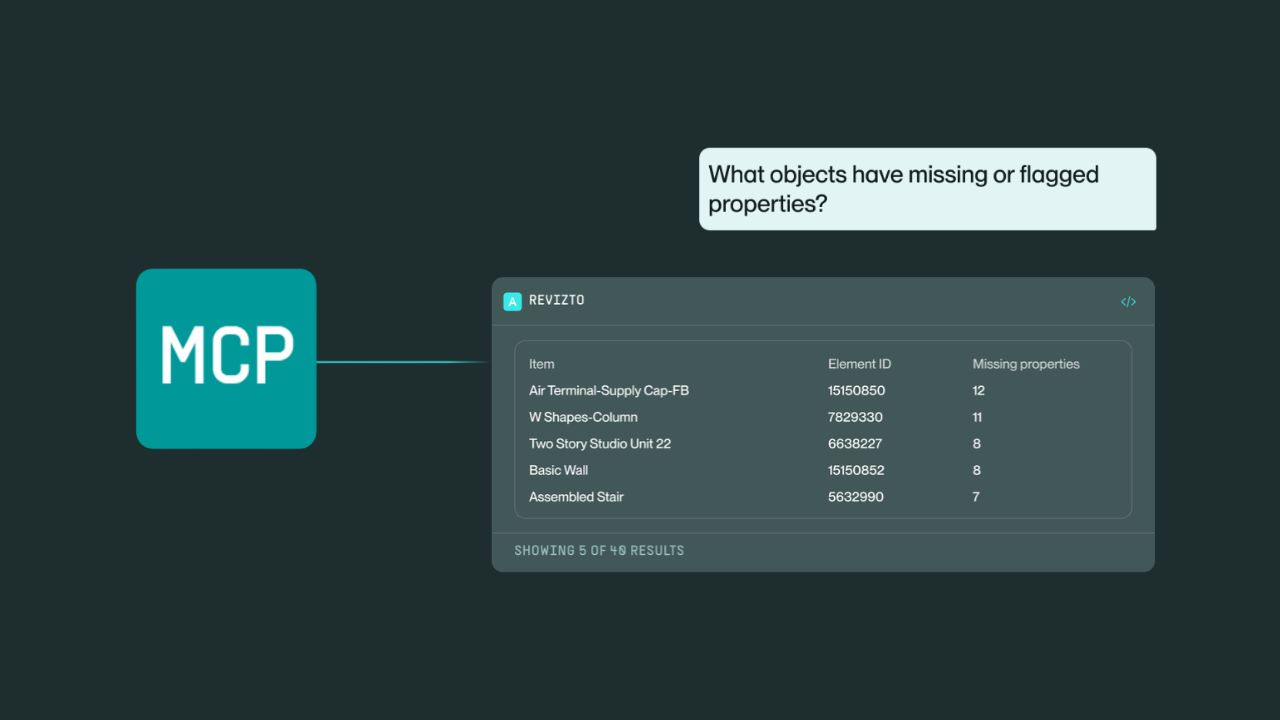
Established software tools provide consistent results, and that gives people assurance. With MCP access, a design team, a subcontractor, or a contractor can use their own AI and feed it from their established software stack. They get more efficiency, and they get assured results, because a human worked on them too.
I expect what comes next to be a mix. Think about how the world economy reacted to electric vehicles. A few years ago they were the future, and today it is a mix of that. It is a human reaction, and we will do the same with AI. It will not be the solution to everything. There will be points where experts are required for critical thinking, to provide the assurances an employer needs. What matters is the structure behind how AI is leveraged.
Why an MCP server is a different conversation from an AI platform
What surprises me is how the industry is reacting to AI. Everyone arrives certain they know everything. Here is an example. An enterprise customer will come to me with a very corporate message about how AI needs to run in their organization, and then send a security questionnaire for AI. But Revizto isn't building a proprietary AI. We offer an MCP server, which lets teams connect the AI tools they have already vetted to their Revizto data, so the AI comes to the data. That is a completely different interaction. When the response is "can you complete the questionnaire anyway?", it tells me we aren't yet having the same conversation.
I would rather pull down some walls and say: I think we are all in the same spot, and we need to work out the right move for the industry. That is what I am working on.
The noise will keep changing. Understanding what your business needs from its information is the work worth doing.
If there is one thing to take away, let it be this
The noise around AI will keep changing. Start from what your business needs from its information and how it is governed, then connect the AI tools you already trust, with established software and human review behind the results.

FAQs
David argues that a stand-alone AI point solution can stray from different results if it is not tended correctly, which is hard to scale in an enterprise. Established software returns consistent results, so pairing it with AI, with a human reviewing the work, gives teams more efficiency and assured results.