What do owners really think about digital construction? Mars Snacking share their story
See how Revizto fits your workflow
Conversations about digital transformation in construction tend to follow a familiar pattern: designers focus on model quality, contractors on coordination, and BIM managers on clash detection. Too often, the owner's perspective is left out - even though owners ultimately absorb the cost of rework.
In an episode of Bridging the Gap: The Conversation, host Kelli Hogan sits down with Aaron Lepley and Steve Cline, Senior Engineers leading VDC and digital delivery at Mars Snacking in North America. What they've built at Mars is rare: an owner-led digital delivery program that doesn't wait for the GC or design firm to set the agenda. Watch the full conversation here, or read on for the key takeaways.
“Owners are usually the problem. They tend to confuse things a little bit”
It takes a certain confidence to walk into a room and say your organization is part of the problem. Aaron and Steve do it anyway, because they know it's true. For them, naming it has been the first step to changing it.
"The owner is usually the problem. The general contractor, the designers, they know what they're doing, they work together a lot, and the owner tends to confuse things a little bit."
Steve Cline, Senior Engineer, Mars Snacking North America
The confusion stems from a knowledge gap more than anything else. Owners often don't know that digital-first workflows exist. They ask for things they can't fully visualize. They sign off on designs they don't entirely understand. And then, mid-installation, the problems surface.
Aaron puts it plainly: "Sometimes what we ask for is not really what we wanted, and then when we get it, it's not what we thought we asked for."
That gap between intent and outcome is where rework lives. And it's largely preventable.
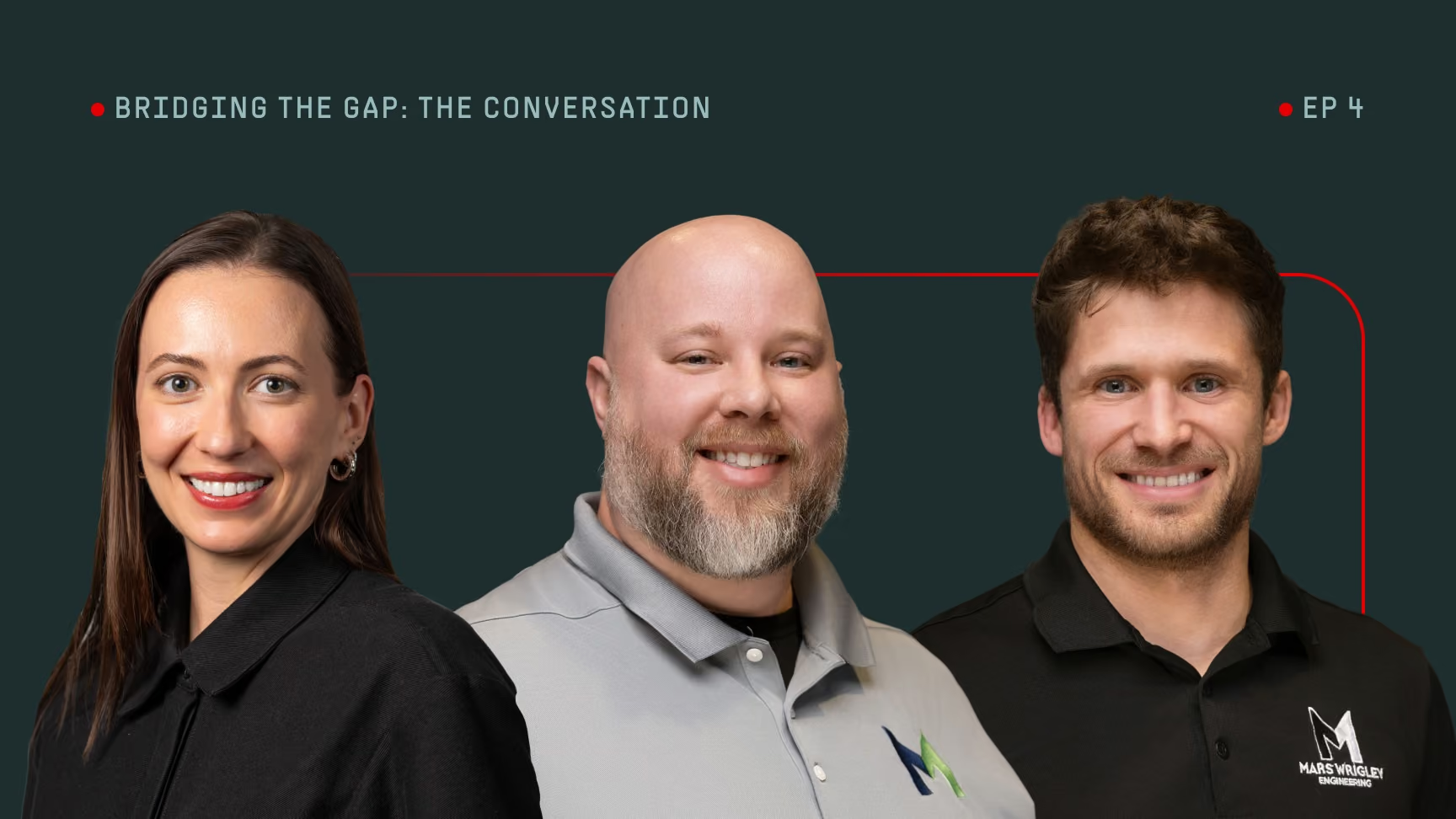
Want to hear how an owner is rethinking digital delivery? Watch the full conversation with Aaron Lepley and Steve Cline from Mars Snacking here.
What happens when you stop building from 2D
According to the 2026 Bridging the Gap report, 60% of AEC professionals still rely predominantly on 2D plans and workflows. For owners, that statistic has direct consequences.
A 2D drawing is hard enough for an experienced engineer to interpret. Asking an operations team to sign off on a space they've never seen, using a format they've never been trained to read, and expecting them to catch access issues, safety concerns, and equipment flow problems is, at best, optimistic.
At Mars, Aaron and Steve made a deliberate shift. Before anything is built, the operations teams who will actually run the equipment are brought into the 3D model. They walk through the space virtually. They assess valve locations, material flow, and basic operational practicalities — while there is still time to change them.
"If you show them a 3D model and they're able to experience it in a one-to-one real-life environment using virtual reality, or even using Revizto to walk through, it absolutely changed everything for us on one of our projects."
Aaron Lepley, Senior Engineer, Mars Snacking North America
The result is fewer surprises at handover, a shorter punch list, and operators who arrive on day one already familiar with the space they're working in.
Key takeaways for owners on 3D workflows:
- Bring operations teams into the model early, not just project engineers
- Use 3D and VR walkthroughs to gather input from non-technical stakeholders before design is locked
- Treat the model as a shared language across the project, not a final deliverable at the end
- Access issues and safety concerns caught in the model cost a fraction of what they cost on site
Why Mars decided to own its construction data
When Aaron and Steve began building out the VDC program, data ownership wasn't an afterthought. It was the foundation.
"Our product, the way we make it, is very proprietary. Protecting our process is number one. If we own the license, if we own the access to the license, if we own the data that's in it, we can take people off the license if we need to. We own it." Aaron Lepley, Senior Engineer, Mars Snacking North America
This matters beyond intellectual property. The construction industry has a data lifecycle problem that most owner organizations don't talk about openly. A project moves from concept through design into execution, and then the data stops. It gets handed to the site team, filed in a vault, and may or may not be maintained. The next time a project kicks off in the same space, the team starts from scratch.
Mars is closing that gap. By owning the process and keeping Revit files, as-built scans, and scan-to-BIM data in a single environment, they've created a continuous data lifecycle. When a new project begins, the existing conditions are already documented, verified, and ready to use.
"We are now starting to recoup the funds that we spent and the time that we spent as it gets recycled into the next project. It's been a very cool cycle to watch actually play out."
Steve Cline, Senior Engineer, Mars Snacking North America
The 2026 Bridging the Gap report found that 96% of CIOs are deeply concerned about data ownership. For manufacturing owners like Mars, that concern is acute. The solution, as Aaron and Steve have demonstrated, is not to outsource data management to a GC or design firm that will move on at project end. It's to own the process from the start.
Key takeaways for owners on data ownership:
- Own the license and the data, not just the deliverable at project end
- Build a data lifecycle that runs from concept through execution and back to concept again
- As-built scans and scan-to-BIM data have long-term value — treat them that way
- GCs and designers move on. Your facility doesn't. The data should stay with you
“People don’t know what you need unless you ask for it“
Time is the number one barrier to technology adoption in AEC, according to the 2026 Bridging the Gap report, cited by 32% of respondents. Teams are stretched. Innovation feels like something that happens after the current project is delivered. It rarely does.
Steve's experience at Mars was no different, at least at first.
What changed wasn't the workload. It was the evidence. As the value of the program became visible, Steve was able to go to his manager and make the case directly: this work is more valuable than the projects I'm currently assigned to. The manager listened, and the time was carved out.
The lesson isn't that transformation is easy. It's that nobody will hand you the conditions to make it happen.
"People don't know what you need unless you ask for it. Ask for the time, make that time valuable, and show the benefit."
Steve Cline, Senior Engineer, Mars Snacking North America
Key takeaways for owners driving digital change internally:
- Don't wait for transformation to be handed to you. Identify the value and make the case for the time
- Start small, demonstrate value, and use early wins to justify deeper investment
- Lean on conferences, peer networks, and communities where practitioners share openly
- Build internal capability so you can bring GCs and design partners up to speed, rather than the other way around
From passive client to informed owner
What makes the Mars story worth paying attention to isn't just the technology.
Aaron and Steve didn't wait for their GC to propose a digital workflow. They didn't outsource the learning or the decision-making. They built the capability internally, took ownership of the data, and created a program that now allows them to bring in partners who have never used these tools before and get them up to speed.
That shift, from passive client to informed owner, is what the industry needs more of. Because when owners understand digital delivery, the whole project ecosystem performs better.
Ready to move from passive client to informed owner? Book a demo with Revizto and see how teams like Mars are using digital delivery to cut rework, own their data, and arrive at handover with fewer surprises.
Or if you’re looking to hear more perspectives from the AECO industry, then join our annual Made Right Conference where owners, GCs, and designers come together to share what's working.
FAQs
Rather than receiving a deliverable at project end and hoping it gets maintained, owners who control their own license and data environment retain access to as-built conditions, scan data, and model files across the full project lifecycle. This accelerates future projects by providing a verified, documented starting point rather than requiring teams to rediscover existing conditions from scratch.
The honest answer is that the time won't be given to you. The case has to be made internally, with early evidence of value used to justify carving out dedicated focus. Starting with one project, demonstrating measurable impact, and building from there is more effective than waiting for a company-wide mandate.
.avif)